
| Serving or Saving: What Factors Drive Service to Others Emily Morton - Pepperdine.edu | |
| go to original December 7, 2021 |
 |
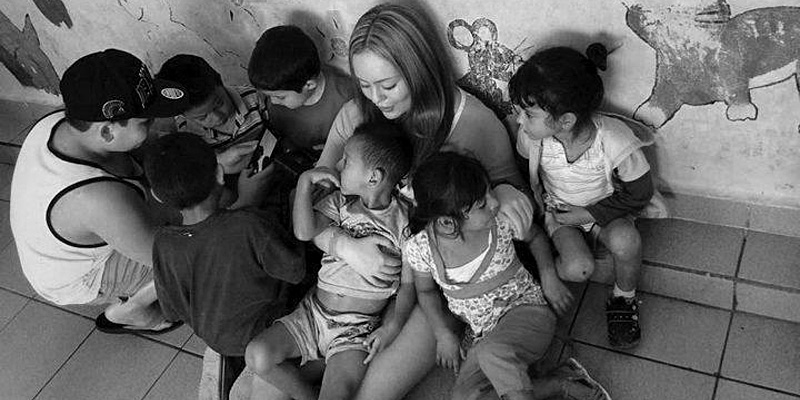

Senior Pia Anderson works with children in Puerto Vallarta as a part of her nonprofit organization, Para Ti Global. Anderson founded this organization with her brother, Luke, to aid communities in Mexico and the Philippines. (Para Ti Global)
“Esto es para ti.” This is for you.
These are the words from a young Mexican boy in 2014 that have stuck with Pia Anderson, a senior Biology and Spanish major. On a family vacation, Anderson and her brother had just finished giving out ice cream to children in a community living inside the city of Puerto Vallarta’s dump when the young boy came back up to Anderson and offered her his ice cream.
“I was someone who was coming from great opportunity and great privilege,” Anderson said. “And he had saved his cup of ice cream for me, because he wanted to demonstrate his selflessness and generosity.”
 His act of kindness touched her and she began fundraising for the area when she arrived home. When she saw the support from her community in Northern California, she started her nonprofit organization “Para Ti Global.”
Anderson’s organization is just one example of service to other communities. Many Pepperdine students volunteer with nonprofit organizations or participate in service projects and mission trips to help those in need. Each instance looks different in the shape they take and the duration, and there are often a lot of ethical questions to navigate on how to help and not hinder those in need.
White Savior Complex
While helping others usually receives praise, critics often point out the unequal power dynamics in international and domestic missions that can taint the experience. Often this is called a “white savior complex.”
The white savior complex “is about having a big emotional experience that validates privilege,” Teju Cole, a Nigerian-American writer and photographer, wrote in an article for The Atlantic. This action can be conscious or unconscious.
“Any kind of ‘savior complex’ is a mission disaster,” said John Barton, director for the Center of Faith and Learning, Religion professor and a former missionary. “No matter how well-intentioned people or projects might be, when we overestimate our own importance and motives, mission is undermined and damage is done.”
The white savior complex can come into play whenever foreign characters come in and decide what is best for the situation without asking the people living directly in the area.
“You can have a white savior complex without being white,” said Daniel Rodriguez, divisional dean of the Religion and Philosophy Division and professor of Religion and Hispanic Studies. “You can have a brown face, like mine, coming from the United States of America, and still be accused of having a white savior complex.”
Rodriguez said the phenomenon of the white savior complex is still around today.
“And it’s alive and well because of our ethnocentrism in this country,” Rodriguez said.
Ethnocentrism is the concept of evaluating another’s culture based on preconceptions from one’s own culture.
Read the rest at Pepperdine.edu

We invite you to add your charity or supporting organizations' news stories and coming events to PVAngels so we can share them with the world. Do it now!
From the Bay & Beyond
Celebrate a Healthy Lifestyle
 From activities like hiking, swimming, bike riding and yoga, to restaurants offering healthy menus, Vallarta-Nayarit is the ideal place to continue - or start - your healthy lifestyle routine.
 Banderas Bay offers 34 miles of incomparable coastline in the states of Jalisco and Nayarit, and home to Puerto Vallarta and Riviera Nayarit's many great destinations.