
| Pelicans are Beachside Beggars in Jaltemba Bay Tara A. Spears - Sol Mexico News | |
| go to original July 4, 2015 |
 |
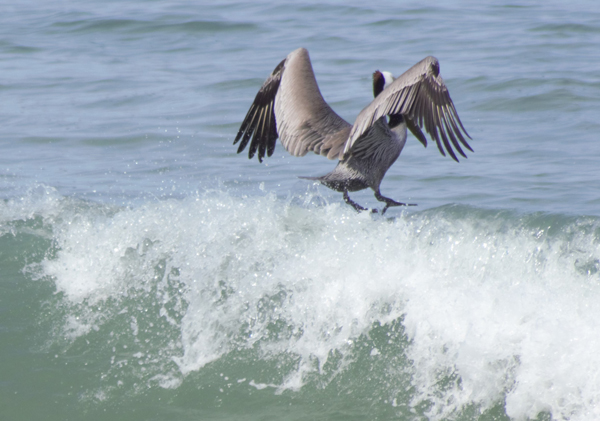
Wave hopping on Jaltemba Bay, La Penita. Photo: Charles Boroughs
The Pacific Brown Pelican, pelecanus occidentalis, are easy to spot in Jaltemba Bay as these large seabirds enjoy begging food from tourists and scarfing up the fishermen’s throwaways as the boats bring their catch to shore. It is a sign of the specie’s evolution that these wild birds have not only learned to tolerate humans but have adjusted their diet to interact with people on the beaches around the world. On California shores the Pacific Brown Pelican will waddle up for a Pringle; in Jaltemba Bay they gobble tortillas; on Ecuadorian shores they munch empanadas in addition to their regular fish diet. Pelicans have always been my favorite seabird because of their amazing behavior, their unique appearance, and their ocean habitat.
Dive bombers: Though they have an awkward gait on land, Brown Pelicans are strong swimmers and masterful fliers. They fly to and from their fishing grounds in V-formations or lines just above the water’s surface. They, and the closely related Peruvian Pelican, are the only pelican species to perform spectacular head-first dives (typically ending in a huge splash visible from far away) to trap fish. Pelicans usually forage during the day, but may feed at night during a full moon. Before swallowing their prey they drain the water from their pouches. If their own dive doesn’t produce dinner, the swift Brown Pelican will steal another bird’s catch!
According to Allbird, “Pelicans usually feed above estuaries and shallow ocean waters within 12 miles of shore, but sometimes venture over the deeper waters past the narrow continental shelf of the Pacific coast.” They occasionally feed by sitting on the surface and seizing prey with their bills, usually when a dense school of fish is close to the surface and the water is too shallow and muddy to plunge. Clever opportunists, Pacific Pelicans also steal food from other seabirds and scavenge dead animals.
Scientific research has disproven the old fishermen’s belief in pelican competition. The pelicans primarily eat fish of little value to humans, as well as salamanders, shrimp, and crayfish. During breeding season, the birds often forage at night, locating fish by touch. While small fish are the major part of their diet, they can eat surprisingly large ones. Brown pelicans also eat some invertebrates, such as squid or prawns. They are a familiar sight around fishing ports within their range, where they roost on piers, docks, and fishing boats, ready to catch fish scraps.
Local Island Sanctuary: Isla Peña
We are very fortunate to have a beautiful little island in Jaltemba Bay that is a breeding spot for several species of seabirds, including the brown pelican. Pelicans nest in colonies for safety. Both sexes build the nest which is a scrap or debris mound on the ground, or a stick nest in a tree. Nesting on islands is the preferred breeding habitat for Pacific Brown Pelicans. Highly social all year, pelicans breed in colonies of up to several thousand pairs — usually on small islands where they are free from terrestrial predators.
Read the rest at Sol Mexico News.
We invite you to add your charity or supporting organizations' news stories and coming events to PVAngels so we can share them with the world. Do it now!
From the Bay & Beyond
Celebrate a Healthy Lifestyle
 From activities like hiking, swimming, bike riding and yoga, to restaurants offering healthy menus, Vallarta-Nayarit is the ideal place to continue - or start - your healthy lifestyle routine.
 Banderas Bay offers 34 miles of incomparable coastline in the states of Jalisco and Nayarit, and home to Puerto Vallarta and Riviera Nayarit's many great destinations.