
| 30 Years for Mexico's EZLN - A Look at Its History: The Option for the Poor Dorset - Upside Down World | |
| go to original December 20, 2013 |
 |
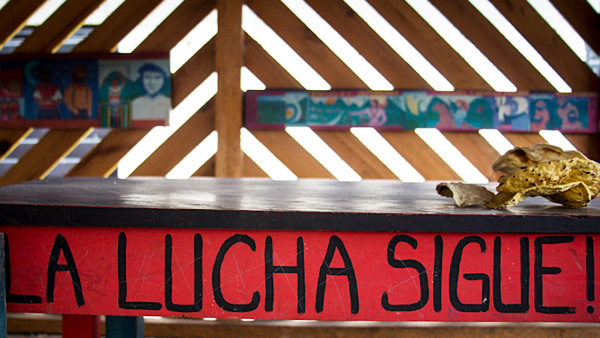
Caracol La Garrucha (Heriberto Paredes)
The Role of Liberation Theology
November 17, 2013, marked the 30th anniversary of the formation of the Zapatista Army of National Liberation (EZLN), and on January 1, 2014 they will celebrate 20 years since their first public appearance. As a form of tribute to the men and women who made that cry of ENOUGH (YA BASTA) echo worldwide, SubVersiones started a series of installments which try to look at the history of the actors who linked together to give rise to the EZLN. The first two parts of this work, the Guerrilla Nucleus and the Millenarian Resistance, were published recently on Upside Down World. In this third and final instalment addresses the current work of the Catholic Church which, under the leadership of Bishop Samuel Ruíz García, had done previous work in the region.
It has not been intended to speak for the Zapatistas, they have told their story and still do so (see Rewind 3). The only goal here is to contribute to the dissemination of their experience, which undoubtedly represents the most advanced alternative in the world.
III. The Option for the Poor
Source: SubVersiones
During the war of conquest and the process of colonization, there were figures who denounced the atrocities carried out by the representatives of the Spanish crown against the indigenous. These voices found an important resonance within the Catholic Church. An exemplary case is that of Fray Bartolomé de las Casas. Centuries later, during the war of independence, two priests again played an important role: Miguel Hidalgo y Costilla and José María Morelos y Pavón. However, it is not until the second half of the 20th century that the role of the church and some of their representatives accompanying social movements was analyzed in depth.
In an attempt to renew and strengthen the Catholic Church, Pope John XXIII convened the Second Vatican Council, which took place between 1962 and 1965. At that meeting ancient differences within Catholicism surfaced, especially those between the "anti-modern" and the "modernist." As part of this Council, Pope Paul VI – who succeeded John Paul XXIII after his death – called on the Latin American Episcopal Council to renew its vision and practice to make it more consistent with the reality of the continent.
In response to this call, various priests in Latin America set out to the task of preparing for the Second General Conference of Latin American Bishops in Medellín, Colombia, in August and September 1968. The conference had a global impact on the Catholic Church due to its composition, the issues addressed and the conclusions it reached.
Read the rest at Upside Down World
We invite you to add your charity or supporting organizations' news stories and coming events to PVAngels so we can share them with the world. Do it now!
Celebrate a Healthy Lifestyle
 From activities like hiking, swimming, bike riding and yoga, to restaurants offering healthy menus, Vallarta-Nayarit is the ideal place to continue - or start - your healthy lifestyle routine.
 Banderas Bay offers 34 miles of incomparable coastline in the states of Jalisco and Nayarit, and home to Puerto Vallarta and Riviera Nayarit's many great destinations.