
| One-on-One with Javier Sicilia of Mexico's 'We've Had It' Movement Raisa Camargo - The Voice of Russia | |
| go to original November 21, 2013 |
 |
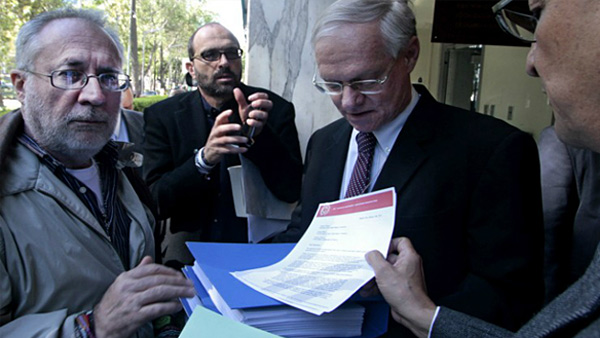
Mexican peace activists Javier Sicilia (L) and Sergio Aguayo (R) hand to US official Michael Glover (2-R), documents signed by 54.558 citizens in support of the ban on the importation of weapons in Mexico, at the embassy of the United States in Mexico City on January 14, 2013. (AFP/Pedro Pardo)
Javier Sicilia, who is known for his poetry and literature in Mexico, became an advocate against Mexico's drug war after the cartels killed his only son, a university student, along with six of his friends in the city of Cuernavaca in 2011.
The frustration led Sicilia to state that he would renounce his poetry.
Since then, he has become a lead figure in organizing protests across Mexico, where hundreds and hundreds have joined under the slogan, "Estamos hasta la madre" or "We've had it." The drug war in Mexico has claimed 80,000 lives to date. The "We've had it" movement transformed into a caravan, with victims and citizens alike showcasing the stories and identities of those who disappeared. The protesters traveled from city to city culminating in Ciudad Juarez.
The movement crossed over into the United States last year in a caravan through communities along the U.S.-Mexican border. This past week, Sicilia stopped in Washington D.C., as part of another tour called “Voices of the Victims,” which extends the agenda to address immigration reform.
We had the opportunity to meet with Sicilia, and invited him to reiterate his viewpoints on the drug war and U.S. policy toward Mexico.
Q. How do you feel being seen as a "voice" of this movement?
I feel very bad. This is not my life. Not my life, nor anyone else's life. To be struggling to have peace and justice is no easy task, because I know we are already in war. In addition, it's also based on a personal tragedy of the assassination of my son, who had nothing to do with drugs. He didn't smoke or consume - and the same goes for his friends who were also killed.
It's not agreeable. It's very sad, very painful to be in these things. I would have liked to keep writing poetry. That is my vocation, plus teaching students literature.
Q. When you began, you composed a slogan that has spread across Mexico: Estamos hasta la madre. What ran through your mind when you wrote this?
I thought my country was corrupt. The politicians had permitted impunity and corruption in the state. I thought the United States had an erroneous political agenda in respect to the guns that killed my son. And that killed a lot of people. I would denounce out loud, to find a path to peace and justice. That is what I was thinking. With much pain and anger I wrote it.
Q. Many people began to question whether a social movement in Mexico would be effective, considering the state of fear caused by the violence. Can you explain the dynamics of the movement?
We broke the fear, and that was fundamental. Nobody had spoken so strongly before. The masses had not come out. The victims were very afraid. We made this movement, and we succeeded in civilizing the victims in exclaiming that this war had victims and the state (government) has a responsibility to them. We also succeeded in forming a victim's law in Mexico that we are currently pushing for enactment. I always say that you have to make something out of life. You can't question whether to do something or not. It's preferable to light a candle, even if it's small, to avoid swearing in the dark.
Q. What is your perception of how the U.S. public is seeing what is going on in Mexico?
I think they understand the problem. The problem is that there are too many political and economic interests at play. The bureaucracy is slow to respond to its service toward the public; its service to the citizens. What we have to do is exercise pressure, what I call a "diplomacy of the citizens" to push these political agendas because while they wait there will be more deaths and there will be more loss of democracy that we will see in our countries, including the United States.
Q. Tell me about the "Voices of the victims" tour and its objectives.
(We've visited) 11 cities more including Canada as well, as part of a follow up to the agenda we opened with the caravan in the middle of last year.
In Washington, we specifically came to insist that the immigration theme, the situation of the migrants, the massive incarceration with migrants in such zones like Arizona - that also includes African Americans, the criminalization of the deaths in my country, the disappeared and the liberal (regulation) of guns in the United States - well it forms part of this drug war that is resulting in more damage than anything. It's necessary to change the politics, but in an integral manner. It's not just the regulation of drugs, but also the control of guns, money laundering, and a good political immigration reform policy.
These three things are fundamental for us to work together - that the governments work jointly to find a path to peace.
Q. Have you spoken with officials in Congress or the Obama administration?
I have spoken with some congress members and personnel close to the Obama administration. We're pushing this agenda. Right now, we are talking to officials at the Organization of American States.
Q. Legalization of drugs might seem "taboo" for some people. In Mexico, how would the process of regulating drugs work?
The drugs are there. They've always been there. It keeps producing and keeps giving to consumers. Prohibition of drug consumption has not reduced one gram of its fabrication. The drug trade corrupts authority, it destroys the social fabric, it promotes war, poverty, violence, the counterproductive negotiation of incarcerations – but legalizing and placing it within the laws of a controlled market and knowing how to use it, where it should go, controlling its quality and along with it making it a health concern for those who have become addicted - this would fundamentally reduce the war. Then we would be able to focus on the real crime. Drugs are not the crime. The crime is human trafficking, extortion, violation of human rights, there is so much that is actually a crime, but comes along and occurs due to the prohibition of drugs.
Drugs are in pharmacies - we have so much drugs that it becomes part of what we're persecuting. It's controlled by the state and we don't have problems. So, we should also change all this demonic construction in respect to drugs because it seems more like a perverse construction to augment violence.
Q. Do you think it should be universally regulated in Latin America? Or do you think that depends, if each case is different?
I think it should be regulated, but every country should know in what way. You can't apply a universal policy.
Q. The case you make to end militarization, for instance with the Merida Initiative, which is a security partnership between the U.S. and Mexico to fight organized crime and money laundering. The counter argument is that without funds going into the Mexican government to help combat the drug cartels this would likely create an atmosphere more rampant with violence.
That's completely false. The money is used to promote the war, to increase violence and the drug cartel violence because the weapons are coming from here. And it's just how the Merida Initiative comes in to legally arm the military and to mark military intelligence. On the other side, it works to supply the criminals.
The U.S. is contributing because they have the market of legal and illegal guns. These guns are what is killing Mexico. If they really want to help this country, they should focus the Merida Initiative on helping to find the disappeared - to give funds to the victims, to give funds to the reconstruction of the social fabric, and to imprison the authorities so as to end the corruption of the state. In that way the funds would serve a better purpose, not to grow the war, if they really want to help us.
Q. What is your perception of how the U.S. government is interpreting what you are proposing?
I think the Obama administration has made a proposal for gun control after the killing in Newtown. Yet, nothing was done. So, I think there are interesting proposals and changes in Washington and in Colorado, like the legalization of marijuana, but it's not being talked about fundamentally, the same way as with gun control. So, I say once again, it's part of Obama's timidity. He is a man with a lot of clarity who understands what is occurring, but he lets (himself be led) by the economic pressures of war and violence. But, I think Obama has a lot of clarity and he has proposals. What he doesn't have is the capacity or the political decisiveness to push it to the finish line.
Q. When do you think you'll reach your limit?
We will continue as long as we can. I am trying to return to my life. But, when you're inside of this you can't return entirely to what was once your life. So, we will be here, while there is injustice, while there is war - we will continue to play a role of pointing out (injustices) and finding solutions.
Q. Will we ever see an end to the drug war?
That is what I hope. That is my expectation, because there is too much pain and if we don't end it, the barbarity and crime will slowly entrench itself in the states. We'll become narco-states. We'll begin to see in our lives forms of totalitarianism that we have not known. I do hope with all my heart and until I am able and can, I will fight so this can end.
See the original at The Voice of Russia
We invite you to add your charity or supporting organizations' news stories and coming events to PVAngels so we can share them with the world. Do it now!
Celebrate a Healthy Lifestyle
 From activities like hiking, swimming, bike riding and yoga, to restaurants offering healthy menus, Vallarta-Nayarit is the ideal place to continue - or start - your healthy lifestyle routine.
 Banderas Bay offers 34 miles of incomparable coastline in the states of Jalisco and Nayarit, and home to Puerto Vallarta and Riviera Nayarit's many great destinations.