
| Mexico City Finds that Grit is Good for Tourism Ruth Samuelson - Fox News Latino | |
| go to original May 4, 2012 |
 |
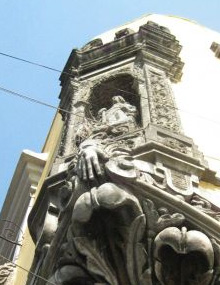 |
| Originally a real hand – belonging to a man that robbed a nearby temple – hung on this building. After it deteriorated, it was replaced with a long-lasting version to warn people to not disrespect the church. (Ruth Samuelson) |
Call it grit tourism. Visitors are looking beyond the elegant plazas to the infamous drug dens and bordellos of Mexico City.
Mexico City’s Centro Histórico lands on every traveler’s checklist. They come for the Metropolitan Cathedral, the huge Zócalo plaza and murals by Diego Rivera.
Then they usually head south to Frida Kahlo’s house.
But Centro’s tough barrios are finally attracting some attention as well. Call it gritty tourism – there are guided trips to cantinas and markets famous for prostitution and drug dens. Nighttime groups stroll areas that many Mexicans, fearing muggings, still wouldn’t enter past sundown.
There’s even a guided visit of the area’s pornographic theaters.
"It’s a tour above all historic, but also anthropological," said David García, whose company runs the tour, "the people that go to these places, they have a series of rituals inside."
García, whose company is called Rec (Recorridos Culturales), gives tours through La Merced, a neighborhood where prostitutes line the sidewalk in broad daylight. The area is also famous for commercial corridors like "Beauty Street," filled with stands offering manicures and fake highlights.
While García’s routes can titillate, he’s mostly interested in the Centro’s history and gives less scandalous tours as well.
Named a UNESCO World Heritage Center in 1987, the Centro sits on Tenochtitlán, the old Aztec capital. It’s where Hernán Cortés toppled the ruler Cuauhtémoc, creating the basis for modern Mexico.
For years, Centro was in decline, due in part to a huge 1985 earthquake. But it recently began repopulating. The city has also pedestrianized various streets, creating new shopping and nightlife zones. Meanwhile, a foundation backed by Mexican Billionaire Carlos Slim has fixed-up building facades.
And many Mexicans, as well as foreigners, are taking advantage.
"There’s an intense reunion of the people of Mexico City and the country with the Centro Histórico," said Inti Muñoz, director of the Mexico City Centro Histórico Trust.
Last year, Muñoz’s organization released "The New Guide of Mexico’s Centro Histórico," which intermingles images of hipster bars, mariachis, remodeled plazas and neighborhood characters, like the female luchadora "Heart of Fire."
Just north of Centro Historico’s core sits Tepito, the city’s most notorious neighborhood. Tepito’s known for sales of stolen electronics, drugs and other illegal goods.
"They’ll rape you, they’ll rob you," said local Lourdes Ruíz about the area’s sometimes far-fetched reputation.
But it also has its own distinct culture. Ruiz is the champion of "albures," statements with double meaning, usually with sexual undertones, that is a popular pastime in the area. Countless Mexican and foreign media, including the BBC, have profiled her.
Alfonso Hernández, a neighborhood historian, occasionally runs tours here from his office, the Center for Tepito Studies. Upon request, he guides groups around the neighborhood according to their interests: the informal economy, Tepiteño food and historical sites.
"Tepito is one of the epicenters of this chaotic city, but Tepito is not a mess like Michoacán, other places, Ciudad Juárez," he said.
Tepito inspires many myths. It’s said everyone gets robbed (not so, said Hernández). Others believe the police don’t operate here. (They’re here, but have no real power, said Hernández).
Foreigners, yes, need to be careful. But as long as they avoid certain streets, they should be fine, he said.
Hernández recently toured a large group from a Swiss urban research organization. They’d spoken to other officials, who recommended they check out the neighborhood.
"Someone said to them, 'This is pure fantasy,'" he said. "To see the real Mexico, go to Tepito."
Ruth Samuelson is a freelance writer based in Mexico City.
We invite you to add your charity or supporting organizations' news stories and coming events to PVAngels so we can share them with the world. Do it now!
Celebrate a Healthy Lifestyle
 From activities like hiking, swimming, bike riding and yoga, to restaurants offering healthy menus, Vallarta-Nayarit is the ideal place to continue - or start - your healthy lifestyle routine.
 Banderas Bay offers 34 miles of incomparable coastline in the states of Jalisco and Nayarit, and home to Puerto Vallarta and Riviera Nayarit's many great destinations.