
| Emerging Economy Growth to Heat Planet Quicker than Expected Ben Garside - Reuters | |
| go to original April 30, 2012 |
 |
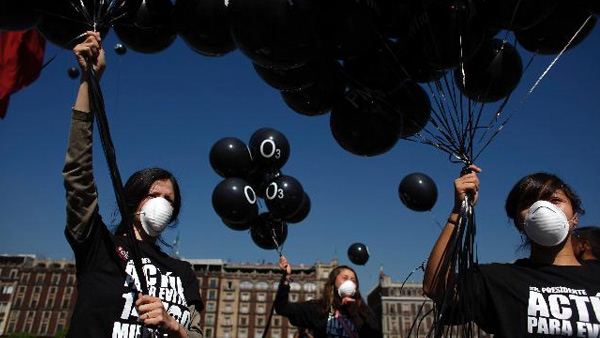
Women hold black balloons during a protest against environmental pollution at the Zocalo square in downtown Mexico City April 26, 2012. Non-governmental organisations released hundreds of black balloons to request the intervention of President Felipe Calderon to prevent the deaths of some 14,700 each year from diseases associated with environmental pollution, according to local media. (Reuters/Tomas Bravo)
The ongoing rapid industrialization of the world's advanced developing economies means global emissions of heat-trapping gases will by the end of the decade exceed safe levels by far more than previously expected, according to a report published Friday.
The report from PBL Netherlands Environmental Assessment Agency said global greenhouse gas output will be at least 50.9 billion tones of CO2 equivalent a year by 2020, 2.5 billion higher than it estimated in 2010, and some 7-11 billion tones beyond levels needed to prevent runaway climate change.
This is despite 87 of 194 U.N. nations setting voluntary targets to rein in their emission output by the end of the decade in a pact struck at a climate summit in Cancun, Mexico, in 2010.
The Cancun talks rescued the U.N. climate process a year after Copenhagen negotiations collapsed without binding countries under a global agreement.
Global emissions are veering further from safe levels largely because booming emerging nations such as Brazil, China and India set floating goals dependent on GDP growth rather than absolute emission caps, according to the report by PBL, a Dutch government agency.
The findings will heap pressure on these countries to deepen their emission reduction pledges, as nations agreed to recognize the need to keep an increase in global temperatures to below 2C at the Cancun summit.
That agreement was based upon scientific findings that recommended developed countries cut their emissions 25-40 percent below 1990 levels and developing countries 15-30 percent below business as usual levels by 2020.
The PBL report said Cancun pledges by developed countries would only lead to cuts of 12-18 percent under 1990 levels by 2020, while developing nations were on track to be just 3-4 percent below projected rates.
We invite you to add your charity or supporting organizations' news stories and coming events to PVAngels so we can share them with the world. Do it now!
Celebrate a Healthy Lifestyle
 From activities like hiking, swimming, bike riding and yoga, to restaurants offering healthy menus, Vallarta-Nayarit is the ideal place to continue - or start - your healthy lifestyle routine.
 Banderas Bay offers 34 miles of incomparable coastline in the states of Jalisco and Nayarit, and home to Puerto Vallarta and Riviera Nayarit's many great destinations.