
| Why the Science Behind Jurassic Park Is a Little Less Far Fetched Richard Conniff - TakePart | |
| go to original October 17, 2013 |
 |
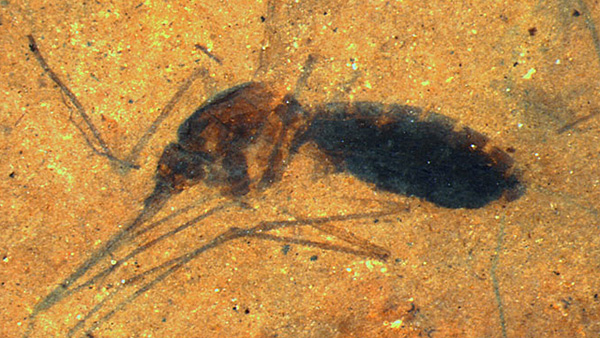
Jursassic Park mosquito (Dale Greenwalt)
Somewhere in the afterworld, Jurassic Park author Michael Crichton must be twitching and grinning with the glee of a science fiction writer proved right, or at least not woefully wrong: Researchers have announced the discovery of specimen USNM 559050, a fossilized mosquito from northwestern Montana, containing what is indisputably a blood meal in its swollen belly.
The specimen, described in the journal Proceedings of the National Academy of Sciences, dates back 46 million years - not quite to the age of dinosaurs, but tantalizingly close. Crichton built his novel Jurassic Park, published in 1990, on what then seemed to be a far-fetched premise: Scientists had supposedly figured out both how to extract DNA from the blood in ancient mosquitoes preserved in amber, and also how to use that DNA to bring the dinosaurs on which those mosquitoes had fed back to life.
That premise is still far-fetched, but now just a smidgeon less so. USNM 559050 turned up not in amber, but in shale, like most mosquito fossils found to date. (The fossils in amber are typically midges, which apparently liked to hang around in a certain type of primordial forest and thus sometimes got trapped forever in amber exuded by resin-producing trees.)
Read the rest at TakePart
We invite you to add your charity or supporting organizations' news stories and coming events to PVAngels so we can share them with the world. Do it now!
Celebrate a Healthy Lifestyle
 From activities like hiking, swimming, bike riding and yoga, to restaurants offering healthy menus, Vallarta-Nayarit is the ideal place to continue - or start - your healthy lifestyle routine.
 Banderas Bay offers 34 miles of incomparable coastline in the states of Jalisco and Nayarit, and home to Puerto Vallarta and Riviera Nayarit's many great destinations.