
| Central Americans Still Determined to Trek North to US Guy Taylor - Washington Times | |
| go to original April 30, 2012 |
 |
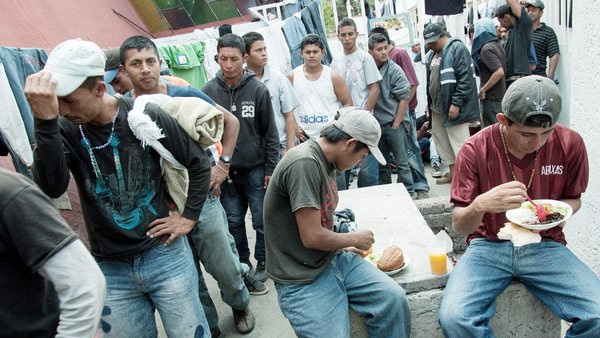
Migrants from Central America wait for a free meal of rice, beans and carrots at the San Juan Diego shelter in Tultitlan, Mexico, one stop on a journey that they hope will end with an illegal crossing into the U.S. (Keith Dannemiller/Washington Times)
TULTITLAN, Mexico — About 200 impoverished and undocumented migrants recently packed into a small building in this ramshackle town 20 miles north of Mexico City.
Nearly all were from Honduras and headed for the U.S. border. Almost none spoke a word in the shelter’s dark main room, where the only thing thicker than the smell of unwashed clothes was a sense of fear.
“Yeah, I’m scared,” said Victor Caseres, 26, who had traveled 750 miles by hopping freight trains to arrive at the shelter, one of more than a dozen run by the Catholic Church in Mexico to provide refuge for migrants.
“Everything’s been all right so far, but going forward, I’m afraid. Sometimes criminal guys hop on the train, and they’ll rob you or kill you.”
Migrants in search of jobs in the U.S. face a gantlet of life-or-death risks in their treks across Mexico from its southern border: Many fall prey to extortion, kidnapping, rape and killing by crooked police and criminal gangs.
It’s a harsh reality that increasingly has undermined efforts by Mexican political leaders to reform their nation’s immigration laws in response to criticism from the international community.
Relief workers say violence against migrants is particularly common along popular transit routes in eastern Mexico, vast stretches of which are controlled by the ruthless Los Zetas drug cartel.
The Zetas make a steady side business in kidnapping migrants, targeting those with relatives already based in the United States who can pay ransoms.
Migrants are killed for refusing to join the cartel or carry drugs across the U.S. border.
Such was the case in August 2010, when the bodies of 72 slain Central and South Americans turned up in a field in northeastern Mexico, about 100 miles south of McAllen, Texas.
Mexico's National Human Rights Commission followed the incident with a report citing the abductions of more than 11,300 migrants in a six-month period in 2010.
The Rev. Pedro Pantoja, a Catholic priest who runs a shelter for migrants in Saltillo, capital of the northeastern state of Coahuila, says the situation hasn’t improved since then.
“The Zetas have free reign to operate with impunity in Coahuila,” Father Pantoja said. “There’s always a presence of organized crime throughout the movement of migrants.
“They dominate the highways and transport vehicles. They follow the migrants on trains.”
What’s worse, Father Pantoja said, is that “they’ve completely infiltrated the police in Coahuila.”
We invite you to add your charity or supporting organizations' news stories and coming events to PVAngels so we can share them with the world. Do it now!
Celebrate a Healthy Lifestyle
 From activities like hiking, swimming, bike riding and yoga, to restaurants offering healthy menus, Vallarta-Nayarit is the ideal place to continue - or start - your healthy lifestyle routine.
 Banderas Bay offers 34 miles of incomparable coastline in the states of Jalisco and Nayarit, and home to Puerto Vallarta and Riviera Nayarit's many great destinations.