
| How Big a Deal Is Walmart's Mexico Bribery Scandal? Sam Gustin - Reuters | |
| go to original April 23, 2012 |
 |
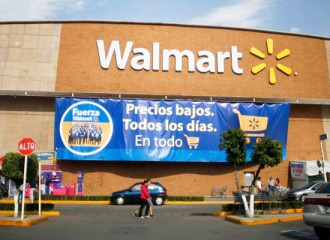 |
| People walk past a Wal-Mart store with a banner reading "Low prices, every day, in everything" in Mexico City April 21, 2012. (Bernardo Montoya/Reuters) |
The Mexican bribery scandal engulfing Walmart rattled investors Monday, sending shares of the company down nearly 5%, and its Mexican subsidiary down over 10%. The key question now is how much damage the scandal will do to the world’s largest retailer. Among the risks the company could face: charges of bribing foreign officials, new questions about foreign operations beyond Mexico, increased regulatory scrutiny and, depending on how the investigation evolves, high-level executive exits.
For Walmart, the bribery scandal is just the latest headache for a company that has become a symbol for a certain breed of American capitalism: outsized, relentless, global, and expansionary. Over the last two decades, Walmart ‘s big-box stores have become a familiar presence across the U.S. — and increasingly throughout the world. But in its quest for growth, the company has faced criticism for undercutting — and ultimately destroying — smaller, local retailers. It has also frequently drawn the ire of labor-rights activists who accuse it of treating its employees poorly.
Here’s what we know so far about the Mexican bribery scandal, via a detailed investigative report by David Barstow of The New York Times:
- Officals at Walmart de Mexico (aka Walmex) allegedly made hundreds of cash payments to government officials — including “mayors and city council members, obscure urban planners, [and] low-level bureaucrats” — totaling at least $24 million, in order to obtain building permits “in virtually every corner of the country.” Walmart is now Mexico’s largest private employer, and 20% of the company’s retail stores are in that country.
- As far back as 2005, officials at Walmart learned of the payments, and sent investigators to Mexico to uncover more details. (Among those briefed was Michael T. Duke, Walmart’s current CEO, who ran the company’s international operations at the time.) The investigators found evidence that senior Walmex executives knew of the payments and sought to conceal them from the parent company. Walmart’s lead investigator concluded in an initial report that there was “reasonable suspicion to believe” that U.S. and Mexican laws had been violated.
- The investigator recommended that the probe be expanded, but according to The Times, Walmart’s leaders “shut it down.” Law enforcement officials were not notified, and Walmex’s CEO Eduardo Castro-Wright, whom the paper said was “identified by the former executive as the driving force behind years of bribery,” was promoted to vice chairman of Walmart in 2008.
- Walmart’s then-CEO H. Lee Scott Jr. “rebuked internal investigators for being overly aggressive.” The investigation was transferred to the general counsel of Walmex, who himself was alleged to have authorized bribes. “The general counsel promptly exonerated his fellow [Walmex] executives,” the paper reported.
So what now for the retail giant? The most obvious risk is that the company could be charged with violating the Foreign Corrupt Practices Act (FCPA), which makes it a crime to bribe foreign government officials. “FCPA cases are both extensive and expensive, including penalties for individuals/entities for both anti-bribery and accounting provisions,” Deutsche Bank retail analyst Charles Grom told Reuters.
Speaking to CNBC, Jacob Frenkel, a former official of the Securities and Exchange Commission, said: “We could easily see criminal prosecutions.”
Upon learning of the paper’s impending story, Walmart opened an internal investigation into FCPA compliance, and says it has held discussions with both the Justice Dept. and the Securities and Exchange Commission. “Acting with integrity is the essence of our corporate culture,” the company said in a statement. “We have the same high standards of integrity for every associate – regardless of his or her position – and everyone is held accountable for those standards.”
Cooperation with law enforcement officials is crucial, Peter J. Henning wrote on Dealbook Monday, because if the company can convince the feds that it is acting aggressively and in good faith, that may limit its exposure to criminal charges or punitive sanctions and fines. “The Justice Department has allowed companies to pay reduced fines and avoid a guilty plea to criminal charges by entering into deferred or nonprosecution agreements because they came forward voluntarily and readily provided information,” Henning wrote.
Henning noted that the statute of limitations for FCPA violations is five years, which suggests that some of the activities described in the article may be beyond the reach of law enforcement. On the other hand, Walmart may still be vulnerable if law enforcement officials can prove that there was a conspiracy to cover up wrongdoing — which only requires that one criminal act occurred in the last five years. Walmart could also be at risk because every year it is required to file financial statements for the previous five years. If the company’s books did not accurately reflect the payments, the company could face charges of violating federal securities law.
Perhaps more ominously for Walmart, the company will now face questions about its operations in countries beyond Mexico. Is it possible that similar practices to the ones alleged in the Times article existed elsewhere? Walmart employs nearly 800,000 workers in 5,651 stores in 26 countries outside the U.S., according to the company. “Before any resolution with U.S. authorities is possible, the company has to look under every stone for possible corruption,” Richard Cassin, an FCPA lawyer, told Reuters. “Are there any similar issues in China or other countries? That’s what U.S. authorities will want to know. Walmart’s shareholders will be asking the same question.”
The scandal has already raised questions about Walmart’s most senior leadership, including CEO Michael T. Duke, who The Times said received a detailed account of the Mexican bribery allegations in 2005, when he was in charge of Walmart International, and ultimately responsible for Mexican operations. “Frankly it’s hard to image how Mike Duke can remain a credible CEO given the report in the Times,” John Marshall, an analyst for the United Food and Commercial Workers capital stewardship program, told Reuters. “It appears that during key moments he was aware of what was going on and apparently may have participated in the cover up.”
We invite you to add your charity or supporting organizations' news stories and coming events to PVAngels so we can share them with the world. Do it now!
Celebrate a Healthy Lifestyle
 From activities like hiking, swimming, bike riding and yoga, to restaurants offering healthy menus, Vallarta-Nayarit is the ideal place to continue - or start - your healthy lifestyle routine.
 Banderas Bay offers 34 miles of incomparable coastline in the states of Jalisco and Nayarit, and home to Puerto Vallarta and Riviera Nayarit's many great destinations.