
| More Than 400 Animals Offered to Aztec Gods A. R. Williams - National Geographic | |
| go to original June 17, 2013 |
 |
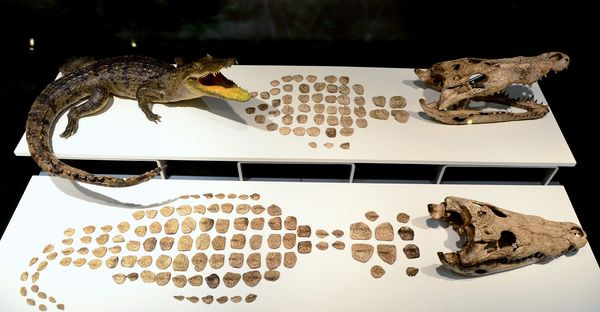
A museum exhibits the bones of crocodiles once offered to Aztec gods. (Héctor Montaño, INAH)
Archaeologists have identified more than 400 species of animals among offerings found at the site of Tenochtitlan, the ancient capital of the Aztecs.
In this great city, the pyramid now known as the Templo Mayor towered above a ceremonial precinct. Beginning in the 14th century, the Aztecs made offerings to their gods there, ritually interring the bodies of animals that held great symbolic meaning for them.
Today the ruins of this holy space lie in the heart of Mexico City. Archaeologists have labored there for more than three decades, uncovering a wealth of information about the culture that Spanish conquistador Hernán Cortés encountered when he marched into central Mexico in 1519.
Some 160 offering deposits have come to light so far, according to a recent report from Mexico's National Institute of Anthropology and History (INAH). About 60 of these included animals, some native to the area and others probably acquired through tribute or trade. The offerings, experts believe, were made between 1440 and 1520, likely to mark new construction phases of the Templo Mayor and nearby sacred buildings. They were dedicated to the two deities whose shrines stood beside each other atop the pyramid—Tlaloc, the god of rain, and Huitzilopochtli, the god of war.
Read the rest at National Geographic
We invite you to add your charity or supporting organizations' news stories and coming events to PVAngels so we can share them with the world. Do it now!
Celebrate a Healthy Lifestyle
 From activities like hiking, swimming, bike riding and yoga, to restaurants offering healthy menus, Vallarta-Nayarit is the ideal place to continue - or start - your healthy lifestyle routine.
 Banderas Bay offers 34 miles of incomparable coastline in the states of Jalisco and Nayarit, and home to Puerto Vallarta and Riviera Nayarit's many great destinations.