
| Inspired by the Jungle: The Zapatistas and the Rise of an Indigenous City Umar Farooq - Upside Down World | |
| go to original March 1, 2013 |
 |
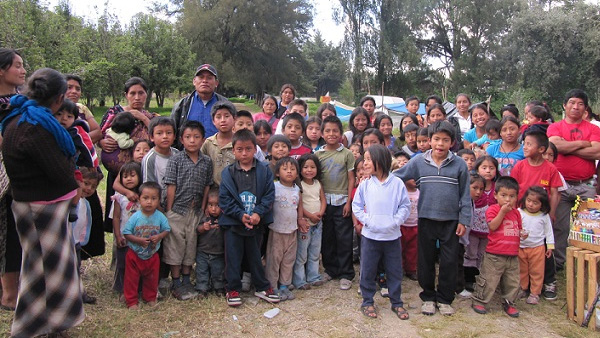
All kinds of indigenous movements draw their inspiration from the Zapatistas, using direct action to secure their rights. Nearly three hundred indigenous families, more than a thousand people, have occupied a large tract of land near the center of the city since last June. In 2009, they first invaded the land, which once housed the National Indigenous Institute (INI), a government body dedicated to helping indigenous people. The governor of Chiapas convinced them to leave after signing documents promising to give them housing elsewhere. When he did not fulfill his promise, they returned.
On December 21, 2012, fifty thousand members of the Zapatista movement, wearing their famed balaclava masks, silently assembled in the town of San Juan Chamula and marched south to the city of San Cristobal de las Casas. It was a highly symbolic gesture.
San Cristobal has changed more in the last two decades than in its entire five hundred year history. A once small town that barred indigenous peoples from staying overnight has been transformed into a city that is half indigenous. The Zapatista revolt in 1994 imbued indigenous peoples in the region with a new-found confidence, and today they constitute a powerful political and economic force that demands the attention of political parties, even some that have long ignored them.
San Cristobal sits in a picturesque, lush valley that has no room left to grow. In 1970, the city's 32,000 inhabitants lived on 13% of the valley's land. By 2002, 112,000 people lived on 98% of the valley's land.
The explosion was due to the influx of internally displaced Tzotzil and Tzetzal-speaking Mayans from the rural highlands of Chiapas, explains Jan Rus, an anthropologist that has witnessed the migration first-hand over the last few decades. Some of the first to come to San Cristobal were Protestants and reformed Catholics that fled sectarian violence in San Juan Chamula. That town's leaders expelled 30,000 fellow indigenous peoples – half the town's population - beginning in 1970, accusing them of upsetting a decades-old political and religious balance.
Read the whole story at Upside Down World
We invite you to add your charity or supporting organizations' news stories and coming events to PVAngels so we can share them with the world. Do it now!
Celebrate a Healthy Lifestyle
 From activities like hiking, swimming, bike riding and yoga, to restaurants offering healthy menus, Vallarta-Nayarit is the ideal place to continue - or start - your healthy lifestyle routine.
 Banderas Bay offers 34 miles of incomparable coastline in the states of Jalisco and Nayarit, and home to Puerto Vallarta and Riviera Nayarit's many great destinations.