
| Soaring Remittances Boost Major Currency Ben Bain and Nacha Cattan - Bloomberg News | |
| go to original April 6, 2012 |
 |
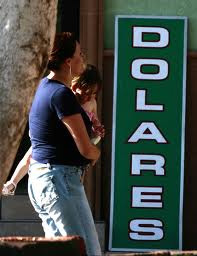 |
MEXICO CITY – Mexicans living in the United States are increasing the amount of money they send home at the fastest pace in a year, boosting the outlook for the world’s best- performing major currency and local bond returns.
Remittances jumped 19 percent in February, the biggest monthly increase since March 2011, to US$ 1.79 billion, the central bank said April 2. The peso has surged 8.5 percent this year, the most among 16 major currencies tracked by Bloomberg. The rally has helped propel dollar-based returns on local debt to 13.5 percent in 2012, almost triple the average gain for emerging-market bonds, according to Bank of America Corp.
Accelerating growth and falling unemployment in the U.S., the world’s biggest economy, are helping fuel the increase in remittances from Mexican workers, according to Alberto Ramos, a Latin America economist at Goldman Sachs. Remittances, which totaled US$ 22.7 billion in 2011, are Mexico’s third-largest source of foreign income after automobile and oil exports, the nation’s mining chamber said in a March report.
“This is a good time actually to send money,” Ramos said in a telephone interview from New York. “Mexican nationals are getting more jobs or at least they feel safer about the jobs that they have, and they feel more comfortable in sending some money home.”
Yields on Mexico’s peso bonds due in 2021 have declined 30 basis points, or 0.3 percentage point, this year to 6.21 percent, according to data compiled by Bloomberg. Yields on similar-maturity Brazilian debt dropped 15 basis points during the same period to 11.17 percent.
The peso will strengthen 2.7 percent by the end of the year to 12.43 per dollar from 12.7632 Tuesday, according to the median forecast in a Bloomberg survey of 25 analysts. Growth in the U.S. economy, the destination for 80 percent of Mexican exports, will quicken to 2.2 percent this year from 1.7 percent in 2011, according to the median estimate of 72 analysts surveyed by Bloomberg. Unemployment in the U.S. held at a three-year low of 8.3 percent in February.
Mexico’s economy will grow 3.43 percent this year, according to the average of 29 economist estimates in a survey released by the central bank April 2. They forecast an expansion of 3.34 percent a month earlier. Central bank Governor Agustin Carstens said in February that Latin America’s second-biggest economy after Brazil may grow closer to 4 percent if the U.S. expansion continues to strengthen.
Stronger remittances help stabilize the peso, meaning “people like me who operate in the external space are more comfortable holding the currency and the local bond curve,” Jeremy Brewin, who helps oversee about $4 billion of emerging- market debt at Aviva Investors, said in a telephone interview from London.
Delia Paredes, chief economist at Grupo Financiero Banorte, said remittance growth may slow if states continue to crack down on undocumented migrants by passing stricter laws.
The Supreme Court said in December it would review a 2010 Arizona law that requires local police to check immigration status if they have “reasonable suspicion” someone is in the country illegally. The Arizona law was the model for about 50 measures in 2011, according to the National Conference of State Legislatures.
“The anti-immigrant laws are making it more difficult for people to cross the border and more difficult for them to stay there,” Paredes said in a telephone interview from Mexico City.
Mexican migrant workers pared money transfers in 2008, with November’s total falling 34 percent, as the U.S. mortgage crisis deepened the recession in the world’s biggest economy and sparked a 20 percent tumble in the peso in the fourth quarter. Historically, more than 95 percent of remittances to Mexico come from the U.S., according to the Washington-based Inter-American Development Bank.
“Those sectors that were highly hit by the recession in 2008 and 2009 are recovering now and that is being reflected in more opportunities, jobs for Mexican immigrants in the U.S.,” Coutino said in a telephone interview from West Chester, Pa. “The impact on the foreign-exchange market is significant” and “as long as the U.S. continues to recover, even though it is a gradual recovery, we will continue to see that Mexicans are getting more jobs, better jobs,” he said.
We invite you to add your charity or supporting organizations' news stories and coming events to PVAngels so we can share them with the world. Do it now!
Celebrate a Healthy Lifestyle
 From activities like hiking, swimming, bike riding and yoga, to restaurants offering healthy menus, Vallarta-Nayarit is the ideal place to continue - or start - your healthy lifestyle routine.
 Banderas Bay offers 34 miles of incomparable coastline in the states of Jalisco and Nayarit, and home to Puerto Vallarta and Riviera Nayarit's many great destinations.