
| Why the Predicted Jellyfish Boom Might Be a Bust Alison Fairbrother - TakePart | |
| go to original January 30, 2013 |
 |
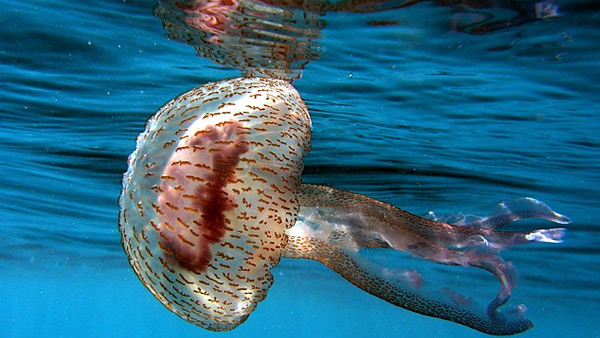
A medusa floats in the sea near the Adriatic town of Split, Croatia, on February 18, 2005. (Matko Biljak/Reuters)
Horror stories of jellyfish clogging fishing nets, shutting down power plants, and stinging innocent beachgoers have increasingly become fodder for the headlines. But a new study analyzing records of jellyfish presence dating back to the 19th century shows that there is no evidence of a global increase in jellyfish over the past two centuries.
Scientists from 30 different countries formed the Global Jellyfish Group to study whether the oceans were undergoing a dramatic jellyfish takeover. They found that jellyfish numbers rise and fall in roughly 20-year cycles, the most recent peak occurring in 2004. The results were published last month in the Proceedings of the National Academy of Sciences (PNAS).
“We looked as far back in time as we could in historical and geological records, to try to determine if there was any long-term pattern that would show an increase in population,” Laurence Madin, director of research at the Woods Hole Oceanographic Institute, and a co-author of the study, told TakePart. “Our conclusion was that there is evidence of a more cyclical pattern, and that jellyfish populations wax and wane over time.”
We are likely in an “up” cycle, Madin said, meaning that we see more jellyfish in the water than we might have 20 years ago, but overall levels have remained consistent over an historical period.
Still, there have been local increases of jellyfish in some parts of the world, prompting concern for fishermen, beachgoers, and industry. Climate change has altered the water temperature in certain ecosystems, providing favorable conditions for jellyfish breeding, and overfishing has depleted populations of predators.
Hawaii has seen a rise in box jellyfish. A huge increase in the number of giant jellyfish in the Sea of Japan has proved problematic: In 2009, a ten-ton fishing vessel was sunk when the crew tried to haul in a net containing dozens of giant jellies.
“What they are experiencing in Japan is real; you can’t just write it off as a global oscillation of jellyfish,” says Mary Beth Decker, a co-author of the paper, and a biologist at Yale University.
What these local increases point to, Decker says, is the need for management strategies that consider each ecosystem individually. To craft effective policy that addresses local influxes of jellyfish, “you have to understand how the ecosystem is behaving, what stresses are in place, and what natural variability exists for that particular ecosystem,” Decker told TakePart.
The Global Jellyfish Group also found that humans have likely played a significant role in creating ideal conditions for jellyfish to flourish. According to a recent paper published in Frontiers of Ecology and the Environment, the increase in jellyfish blooms in certain ocean ecosystems is likely due to the expansion of sea “sprawl,” artificial structures like docks, rigs, and piers, which provide an ideal habitat for jellyfish nurseries.
We invite you to add your charity or supporting organizations' news stories and coming events to PVAngels so we can share them with the world. Do it now!
Celebrate a Healthy Lifestyle
 From activities like hiking, swimming, bike riding and yoga, to restaurants offering healthy menus, Vallarta-Nayarit is the ideal place to continue - or start - your healthy lifestyle routine.
 Banderas Bay offers 34 miles of incomparable coastline in the states of Jalisco and Nayarit, and home to Puerto Vallarta and Riviera Nayarit's many great destinations.