
| Canada's Guest Worker Program Could Become Model for US Immigration Changes Nick Miroff - The Washington Post | |
| go to original January 6, 2013 |
 |
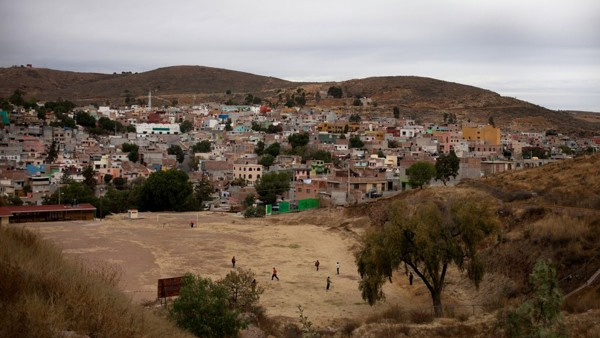
Children play in a soccer field outside Zacatecas. Workers from this region have been traveling to the United States to work for more than 120 years. (Dominic Bracco II/The Washington Post)
OJOCALIENTE, Mexico — When Oscar Reyes heads north for seasonal work every spring, he no longer pays a smuggler to sneak him through the desert past the U.S. Border Patrol.
He takes Air Canada.
Reyes earns $10.25 an hour tending grapes and spraying pesticides at a vineyard in British Columbia’s Okanagan Valley, working eight months straight, seven days a week.
He was one of nearly 16,000 temporary workers from Mexico imported by Canada last year, part of a government-to-government agreement that Mexican officials view as a potential model for an expanded “guest worker” program in the United States.
“I come home loaded with money, and I don’t have to worry about anything,” he said during a visit home for winter, his family gathered around the table and brand-new toys scattered across the living room.
With President Obama’s reelection in November, and the overwhelming support he received from Hispanic voters, expectations are high that he will take up the nettlesome cause of U.S. immigration reform in his second term.
If so, the most contentious issue is likely to be the fate of the 11 million or so illegal immigrants living in the United States. But the debate is also expected to include proposals for a massive expansion of temporary worker programs to meet future U.S. demand for legal, low-skilled labor.
The United States gives out about 50,000 seasonal agricultural visas per year, nearly all of them to Mexican workers. But U.S. farmers, immigrant advocate groups, labor unions and Mexican officials say the current U.S. program is a mess: inefficient, bureaucratic and vulnerable to abuses by swindlers who charge potential workers thousands of dollars to find jobs for them and prepare their visa applications.
The frustrations have left many looking north, to Canada, where government officials partner with their Mexican counterparts to recruit workers, expedite visas, guarantee health and safety standards, and coordinate travel arrangements and pay.
They also go to extraordinary lengths to make sure the workers go back to Mexico at the end of the season.
Mexico’s new President Enrique Peña Nieto said he has told Obama his administration is keen to “contribute” to a push for U.S. immigration reform.
Such talk would have been too politically sensitive just six years ago, when the volume of Mexican migrants crossing the border was seen as out of control and the U.S. Border Patrol was making more than a million arrests a year.
Last year, the Border Patrol made just 340,000 apprehensions, the lowest level since 1971, the result of a tighter U.S. job market, stiffer U.S. enforcement and widespread fears in Mexico of the kidnapping crews and drug gangs who roam the borderlands.
Overall, nearly as many Mexicans are now leaving the United States, whether voluntarily or as deportees, as the number who arrive, a trend that has raised alarms of labor shortages in industries historically dependent on low-paid migrants, like food service and farming.
“For anybody who believes that there will be a wild and endless flow of [Mexican migrants] into the future, that's just not realistic,” said Craig Regelbrugge, vice president for Government Relations at the American Nursery and Landscape Association, a trade group.
We invite you to add your charity or supporting organizations' news stories and coming events to PVAngels so we can share them with the world. Do it now!
Celebrate a Healthy Lifestyle
 From activities like hiking, swimming, bike riding and yoga, to restaurants offering healthy menus, Vallarta-Nayarit is the ideal place to continue - or start - your healthy lifestyle routine.
 Banderas Bay offers 34 miles of incomparable coastline in the states of Jalisco and Nayarit, and home to Puerto Vallarta and Riviera Nayarit's many great destinations.