
| Latin America and Caribbean See Advances in Battling HIV/AIDS Cesar Morales Colon - Infosurhoy.com | |
| go to original December 31, 2012 |
 |
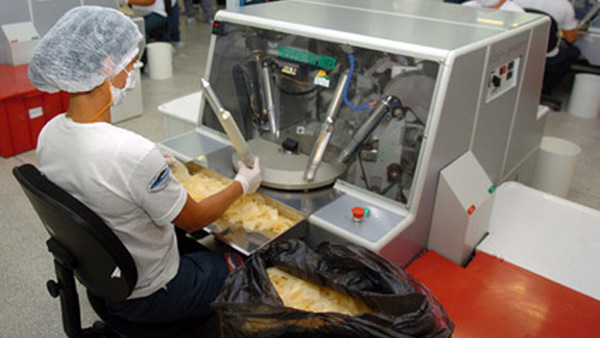
Brazilian officials distribute about 500 million condoms annually, with 100 million produced at a factory owned by the government in the state of Acre. The plant uses latex extracted from wood in the reforestation area of the Chico Mendes Extractive Reserve. (National STD Program)
HIV infection rates have reached a plateau in Central and South America while a considerable reduction has been noted in the Caribbean, according to the 2011 World Aids Day report by the Joint United Nations Program on HIV/AIDS (UNAIDS).
The decrease is largely due to improvements in distribution of antiretroviral drugs and a better spread of information on prevention, according to UNAIDS.
Throughout Latin America, “a steady decrease in new annual HIV infections since 1996 leveled off in the early 2000s and has remained steady since then at [an estimate of] 100,000 each year,” the report, released Nov. 21, states.
The report estimated 1.5 million were living with HIV in 2010 in Latin America, up from 1.3 million in 2001.
In the Caribbean, a region with the second-highest prevalence of HIV behind Sub-Saharan Africa, the pandemic has slowed significantly in the past decade.
“HIV incidence has decreased by an estimated 25% in the Dominican Republic and Jamaica since 2001, while in Haiti it has declined by about 12%,” the report states.
Better access to antiretroviral therapy, also known as Highly Active Antiretroviral Therapy (HAART) – a combination of medications that inhibits the life cycle of the virus, significantly thwarting its capacity to reproduce – is the main weapon the region is using to help those who are HIV-positive.
There were 67,000 AIDS-related deaths in Central and South America in 2010, down from 83,000 in 2001, according to the report. In the Caribbean, AID mortality decreased significantly, down to 9,000 in 2010 from 18,000 in 2001.
“We have seen a massive scale-up in access to HIV treatment, which has had a dramatic effect on the lives of people everywhere,” said Michel Sidibé, executive director of UNAIDS.
Throughout Latin America, governments and NGOs are focusing on prevention as well as treatment of patients who are HIV-positive.
Honduras: A plate on the table
Those who are HIV-positive in this Central American nation of eight million often become homeless, lose their jobs and become victims of discrimination.
“It is hard to be HIV-positive, because when the family found out they even assigned me a separate plate to eat my meals,” said Sergio, a 49-year-old in Tegucigalpa who is HIV-positive. He declined to give his last name because of the stigma still attached to the virus.
When he came to the Association for a Better Life of People Infected with HIV/AIDS in Honduras (APUVIMEH), he was provided with free meals, shelter and care.
“Here, they give me food,” said Sergio, who was diagnosed HIV-positive in 2002. “They give me medicine and nobody discriminates against me. Now, I feel better.”
But Sergio’s story is more the exception than the rule, as just 8,018 of the country’s 29,755 who are HIV-positive receive treatment, said Dr. Héctor Galindo Castellanos, chief of the Sexually Transmitted Diseases and HIV/AIDS department of Honduras’ Health Secretariat.
“We need to do more to educate people about the disease and its treatment,” Castellanos said.
Guatemala: Zero stigmas
In Guatemala, the country’s National Program for Sexually Transmitted Diseases and HIV has launched the “Cero Estigma” (Stigma Zero) campaign, aimed at eradicating social stigmas attached to HIV/AIDS and encouraging people to be tested for the disease.
“The main hurdle for an effective detection of the disease is social stigmatization,” said Claudia Samayoa, the program’s director.
There are 22,647 HIV-infected people in Guatemala, according to National Center of Epidemiology of the Ministry of Public Health and Social Assistance.
“The United Nations estimates that in the country there might be up to 60,000 infected without knowing it,” Samayoa said. “Our goal is to bridge the gap between detected cases and these estimates by early detection campaigns.”
The government has allocated 60,000 rapid test kits for the “Stigma Zero” campaign next year, she said.
Authorities also plan to provide Guatemala’s indigenous, a demographic where the HIV infection rate is rising, with prevention materials printed in several local languages, such as nam, quiché and xinca, Samayoa added.
Mexico: Emphasis on pregnancies
The country’s National Center for Prevention and Control of HIV/AIDS (CENSIDA) started a poster campaign last October to raise awareness among expectant mothers on the importance of taking an HIV test.
“If you are pregnant, get HIV tested,” read the signs, which are posted in trains and Metro stations throughout Mexico City.
“If [someone who is pregnant] tests positive, the patient will receive treatment that considerably reduces the chances of having the disease transmitted to the child,” said Carlos García León, director of prevention and social involvement at CENSIDA.
If antiretroviral treatment is administered before the fourth month of pregnancy, the risk of infection for the child during gestation is reduced to 2%, according to Dr. Ana Ramos of Mexico’s Social Security Institute (IMSS).
Brazil offers a model for AIDS treatment and prevention
In 1987, when the first drug cocktail for the treatment of AIDS – azidothymidine (AZT) – hit the market, Brazil had a total of 2,775 HIV-positive cases. Two years later, it hit 6,295.
Three decades later, Brazil offers free treatment through its National Health System (SUS) to 215,000 who are HIV-positive.
“In 1987, when we started to distribute AZT, the survival rate of HIV-positive cases was counted in months. Now, we can say there’s a chance you will survive an HIV infection,” says Dirceu Greco, director of the Ministry of Health’s Department of STDs, AIDS and Viral Hepatitis.
Greco, a physician specializing in infectious diseases and professor at the Federal University of Minas Gerais, said Brazil has set an example with the way it fights the disease.
“The government’s determination, with the SUS as the main actor, in partnership with universities and social movements, were crucial factors contributing to the success of the program,” Greco said. “Each year, the country invests R$1.4 billion (R$ 800 million) for medicine alone and the rest for the operational aspects of treatment and prevention.”
Brazilian officials distribute about 500 million condoms annually, with 100 million produced at a factory owned by the government in the state of Acre.
The Brazilian model is considered to be exemplary and is classified as one of the best in the world, according to the Joint United Nations Program on HIV/AIDS (UNAIDS).
Cristine Pires contributed from Porto Alegre, Brazil, René Novoa from Tegucigalpa, Honduras, Sergio Ramos from Mexico City, and Antonio Ordonez from Guatemala City.
We invite you to add your charity or supporting organizations' news stories and coming events to PVAngels so we can share them with the world. Do it now!
Celebrate a Healthy Lifestyle
 From activities like hiking, swimming, bike riding and yoga, to restaurants offering healthy menus, Vallarta-Nayarit is the ideal place to continue - or start - your healthy lifestyle routine.
 Banderas Bay offers 34 miles of incomparable coastline in the states of Jalisco and Nayarit, and home to Puerto Vallarta and Riviera Nayarit's many great destinations.