
| Pictures: Mysterious Maya Tomb Explored for the First Time Since 1999 Discovery National Geographic | |
| go to original November 30, 2012 |
 |
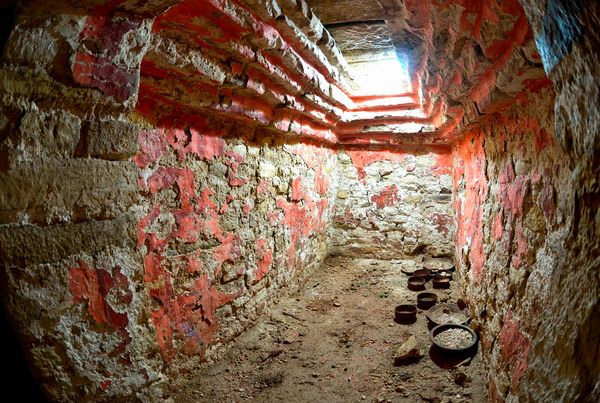
Entering the Tomb - An entrance to a Maya burial chamber is decorated with vibrant red wall murals—the first look scientists have gotten of a mysterious tomb discovered in 1999.
For the first time, a team of researchers from Mexico's National Institute of Anthropology and History (INAH) recently entered the tomb, which also contains 11 vessels as well as pieces of jade, according to an INAH statement.
A commonly used color often chosen for royal tomb adornment, red signified blood to the Maya and was considered a sacred life force, said David Stuart, a Maya scholar at the University of Texas, Austin.
The tomb is located in southern Mexico in a jungle-shrouded area called Palenque, a powerful Maya political center from A.D. 500 to 700 and now a famous archaeological site.
So who is buried within? It's too soon to tell, as no human bones have been studied at this point. But further excavation will likely unravel the mystery of who was laid to rest here and why.

Seeing Red - Perhaps the tomb's most captivating characteristics are the bright, crimson murals painted within (pictured).
These particular murals, Stuart said, are of "a very strange style" for Palenque, which is known for its realistic renderings of figures.
"These are more schematic, and look like they were painted quickly."
The Maya empire dates to as far back as 8,000 B.C., and rose and fell over a period of 3,000 years. This Mesoamerican civilization - which spread across modern-day Guatemala, Belize, El Salvador, Mexico, and Honduras - is known for its incredible buildings, many of which still stand today, as well as cultural and scientific achievements.

Shedding Light - Now that they have access, researchers are excavating the roughly 1,500-year-old tomb (pictured).
After it was first found, a remotely operated camera was sent down to photograph its interior - but nobody has been allowed to enter until now.
According to INAH, the burial chamber is 7 meters (23 feet) below the top of the tomb, which is located inside what's called Temple XX at Palenque.

Mysterious Occupant - Nine figures, such as this close-up profile, are depicted on the tomb's walls.
INAH hypothesizes that its occupant could be K'uk' B'ahlam, who reigned from A.D. 431 to 435 and was the founder of Pakal's dynasty.
But the style of the tomb and the ceramics inside it seem to place the structure later, in the sixth century, Stuart noted.
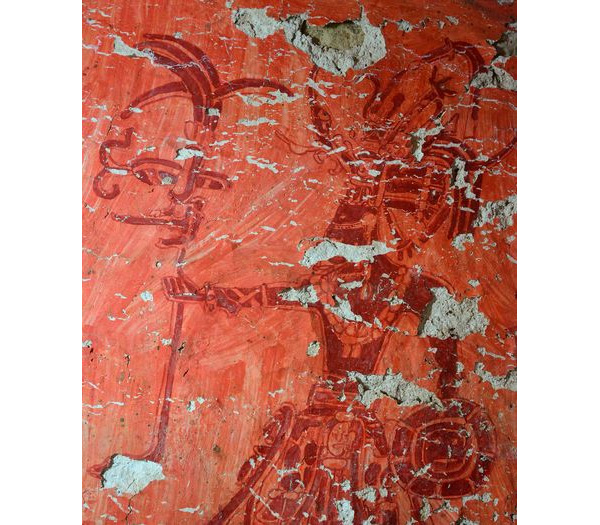
"Snake Jaguar" King - Sporting an elaborate headdress and shield, the Palenque king named Kan Bahlam, or Snake Jaguar, is depicted on one of the tomb walls.
Eight other figures are depicted as well, "each probably a different royal ancestor of the tomb occupant," said Stuart.
"The imagery of nine ancestors seems to have been a theme repeated in other Palenque royal tombs, such as Pakal's own huge one in the Temple of the Inscriptions."
The region's most famous king, Pakal, came to power in A.D. 615 at age 12 and ruled until he was in his 80s. He turned Palenque into a thriving, world-class city. Because Pakal built over much of what existed before him, little is known about the time prior to his ascension to power.
If this tomb predates the famous king, as INAH and Stuart suspect, its contents could offer clues about life in pre-Pakal times.
It's unclear yet what might be found inside, but it's "cool enough," said Stuart, that there's now "firm archaeological evidence of a Palenque ruler from the years before Pakal's reign."
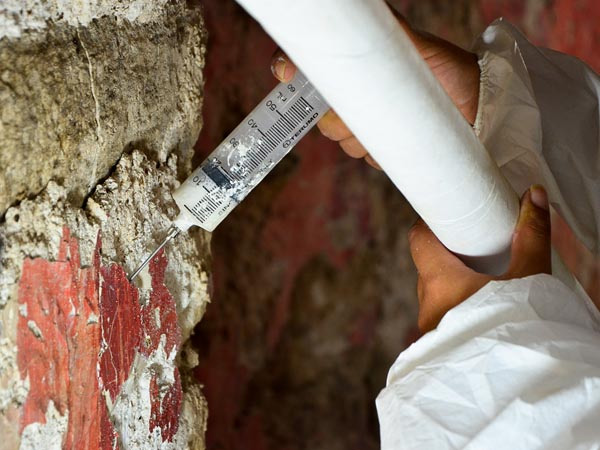
Work in Progress - A person injects lime into a mural to prevent the paint from further erosion.
Further excavations will help date the tomb and perhaps identify its occupant. According to INAH, the research team is made up of 60 people, though only two or three are allowed in at a time, in special clothing, so as not to disrupt the area's temperature and humidity.
While the discovery itself isn't new, the fact that the tomb has been opened is important, said Stuart.
"We don't know a lot about the pre-Pakal era, so this is one of the few clues we have about the architecture and history of the time."
Photography courtesy Héctor Montaño, INAH
We invite you to add your charity or supporting organizations' news stories and coming events to PVAngels so we can share them with the world. Do it now!
Celebrate a Healthy Lifestyle
 From activities like hiking, swimming, bike riding and yoga, to restaurants offering healthy menus, Vallarta-Nayarit is the ideal place to continue - or start - your healthy lifestyle routine.
 Banderas Bay offers 34 miles of incomparable coastline in the states of Jalisco and Nayarit, and home to Puerto Vallarta and Riviera Nayarit's many great destinations.