
| Mexico's Disarmament Alternative: Money, Products for Weapons Alicia Calderon - Infosurhoy | |
| go to original March 29, 2012 |
 |
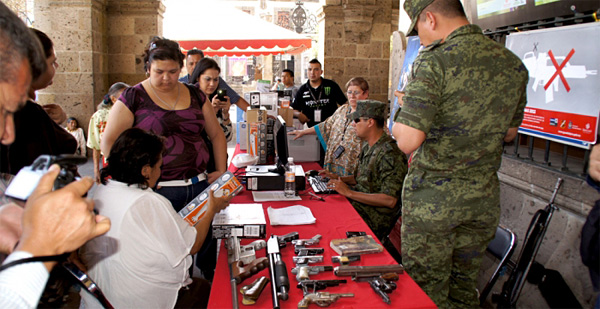
The March disarmament campaign was necessary because of the growing wave of gun-fueled violence that has engulfed a nation where residents often become casualties in the bloody turf war waged among narco-trafficking and criminal organizations. (Alicia Calderón/Infosurhoy.com)
GUADALAJARA, Mexico – Margarita de López Santiago was scared as she clutched her purse containing a gun and dozens of bullets tightly against her stomach while walking toward downtown Zapopan, afraid the weapon would discharge or police would stop her.
She didn’t know how to use the gun, didn’t know whether it was loaded, but she was certain she no longer wanted the gun, which had been kept in a locked box in her home for 10 years. It wasn’t even hers, as her cousin left it with her as collateral for borrowing some money and never returned to pick it up.
Now, López Santiago, 55, got to say goodbye to the gun and hello to $500 pesos (US$59.34) which she received by turning in the weapon at one of the many Weapons Collection and Exchange Program centers established by the National Defense Secretariat (SEDENA) and municipal governments as part of a nationwide campaign.
Since the start of the month, officials have enticed residents to turn in their firearms and bullets in exchange for new appliances, such as an iron, blender, coffeemaker, portable DVD player or a TV. At some exchange centers, officials offer cash or vouchers that can be redeemed for household items, sporting goods or food.
The March disarmament campaign was necessary because of the growing wave of gun-fueled violence that has engulfed a nation where residents often become casualties in the bloody turf war waged among narco-trafficking and criminal organizations.
But officials believe the more guns they can remove from circulation, the more secure residents will feel, said Zapopan mayor Héctor Vielma Ordóñez.
“The current conditions of insecurity and violence that extend to all the corners and cities of Mexico have forced municipal authorities to substantially modify their protocols, prevention programs and the role they play within the communities they serve,” Vielma Ordóñez said at the ceremony to welcome the exchange program, which ran from March 14-18, to his town in the Guadalajara metropolitan area.
SEDENA uses a formula to determine how much compensation owners receive for turning in weapons. The minimum payment is $300 Mexican pesos (US$23) that can be redeemed in cash or in products, and is normally given for unusable firearms. However, large, high-caliber weapons can be turned in for $3,000 Mexican pesos (US$232) in cash or products.
No questions asked
María Mendoza Ramírez, 67, was afraid to visit the exchange center in Guadalajara because she didn’t know very much about the .22-caliber pistol that been unused inside her home for years.
Was it once used in a crime? And if it was, would she face charges if she tried to turn it in?
But those questions are moot because according to SEDENA policy, officials simply take the weapons and ammunition without asking any questions, and no background checks are made for those relinquishing their firearms. In some cases, they don’t even have to show proper identification.
“We even give them a receipt stating that they are not liable for any present or future problems,” said Francisco Partida, who ran the exchange center in Zapopan and works for SEDENA’s Department of Crime Prevention.
Mendoza Ramírez, who left the center with a new blender, said she made the right choice.
“I didn’t want to come, to be honest, but they kept insisting on the radio and I was tired of having it at home, hidden so that nobody would grab it, like my grandchildren or someone who didn’t know how to handle it,” said Mendoza Ramírez, who wrapped the pistol in layers of cloth so she wouldn’t have to touch it. “Can you imagine what would happen then? You can’t throw it out or give it away, because you don’t know whose hands it will wind up in.”
In the Guadalajara metropolitan area, the exchange program has been a success, as about 50 weapons were relinquished in Zapopan, while in Guadalajara, 197 weapons were collected, including 61 .22-caliber, 36 .38-caliber and 21 .40-caliber guns, in addition to 2,360 rounds and 60 cartridges of ammunition, according to the Public Safety Secretariat in Guadalajara.
Of the 197 weapons collected, 118 were from men and the rest by women.
Col. Dagoberto Hernández Santiago, commander of the 79th Infantry Battalion of the Fifteenth Military Zone, located in Guadalajara, said that in some cases in other municipalities, nearly 95% of the people who turn in weapons were women.
“They are among the most concerned for the safety of their families,” he said.
The program, he added, was also recently implemented in the municipalities of Tlaquepaque, Tonalá, El Salto, Ixtlahuacán de los Membrillos and Juanacatlán, all near Guadalajara. In these communities, a total of 42 pistols and 17 larger weapons were exchanged, of which only 10% were inoperable.
As of 2011, the National Defense Secretariat had legally registered about 26,400 pistols and 15,900 larger weapons.
Col. Hernández Santiago said that SEDENA does not maintain estimates of the quantity of illegal weapons in circulation, but authorities have placed a high priority on stopping weapons trafficking.
A 2010 study conducted by private security firm Grupo Multisistemas de Seguridad (GMSI) calculated that there are 15,000 illegal firearms in Mexico, 80% of which are in the hands of criminal groups.
Still, Vielma Ordóñez said the exchange program has made streets safer.
“One less weapon is one less threat to our children and our families,” he said.
We invite you to add your charity or supporting organizations' news stories and coming events to PVAngels so we can share them with the world. Do it now!
Celebrate a Healthy Lifestyle
 From activities like hiking, swimming, bike riding and yoga, to restaurants offering healthy menus, Vallarta-Nayarit is the ideal place to continue - or start - your healthy lifestyle routine.
 Banderas Bay offers 34 miles of incomparable coastline in the states of Jalisco and Nayarit, and home to Puerto Vallarta and Riviera Nayarit's many great destinations.