
| College Students Urge Metro Riders to Be Courteous Sergio Ramos - Infosurhoy.com | |
| go to original November 22, 2012 |
 |
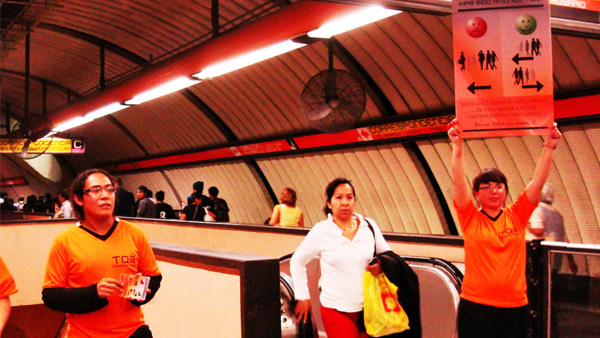
Dressed as soccer referees, students from the University of the Cloister of Sor Juana patrol the corridors, platforms, and train cars of the Mexico City Metro system, carrying signs urging riders to follow basic rules of courtesy. Officials said the group has made the Metro safer. (Ponte la del Metro)
MEXICO CITY – Shoving, rudeness and crisscrossing through restricted areas are just some of the misconduct demonstrated by a portion of the five million who use the Mexico City Metro system every day in this bustling city of 21 million.
But Ponte la del Metro (Get with the Metro), an advocacy group comprised of students of the Humanities program at the University of the Cloister of Sor Juana (Universidad del Claustro de Sor Juana), wants the disobedience to stop.
“Do we know how to use this form of transportation correctly? The answer is no,” the collective says in Ponte la del Metro’s website.
“We need to start worrying about other people and understand that we’re not riding by ourselves,” said Jorge Durán Solórzano, one of the project founders. “We need to recognize the Metro as a public space and show civility when we use it.”
That’s why in October 2011 the students launched a campaign in which they work with authorities from the Collective Transportation System (STC) to promote a culture of etiquette in all public spaces, specifically the Metro.
The students dress as soccer referees and position themselves throughout the platforms, escalators, and corridors at the busiest stations of the Mexico City Metro between the peak hours of 3 p.m. and 6 p.m.
If a “referee” spots a rider breaking a rule, whether it’s walking the wrong way down a corridor, crossing a yellow line that separates the platform from the tracks or being too aggressive, he or she is given a “penalty card,” a leaflet listing the following rules:
- Avoid pushing others;
- Respect the yellow line;
- Allow riders to exit cars before boarding;
- Stand to the right on the escalators;
- Do not walk down a corridor in the wrong direction;
- Do not force automatic doors to remain open;
- Relinquish your seat to senior citizens, pregnant women and disabled riders;
- No littering;
- Yield to riders who are in a hurry;
- Do not buy merchandise from unofficial vendors.
“The lack of awareness about the other riders and about the space itself creates small problems that undermine other people’s quality of life,” Durán said.
Ponte la del Metro came out of a Cultural Projects class assignment within the Humanities program at the University of the Cloister of Sor Juana.
Eleven students appealed for assistance to the STC, the university and the Historic Center Rescue Trust, an institution that since 2002 gathers citizens, entrepreneurs, and the government to protect and preserve the historic center of Mexico City.
The Historic Center Rescue Trust supported the students by providing posters, while the university gave them uniforms, stands, signs, chairs and leaflets.
The student group first gathered in the Tacuyaba Metro station, which runs west-north, connects lines 1, 7, and 9 and is used by about 51,000 riders daily.
“The reactions were positive and negative,” Durán said about the group’s first day. “But most of them were favorable. The riders congratulated us on the project.”
Estela Osuna, a 64-year-old clothing retailer who rides the No. 7 line every day, was one of the first to receive a “penalty card.” She was spotted walking briskly down the wrong way of a one-way corridor because she wanted to avoid crowds and board the next Metro car after a long day of work.
“I’d rush down the corridors in the wrong direction because they were empty, or I’d cross over the yellow line to be the first one to get in the car and grab a seat,” she said.
When she was presented a “penalty card,” she didn’t even know Metro had rules.
“At first I was annoyed because they reprimanded me, but now, after reading the leaflets these young people distribute, I make sure to follow the rules,” she said.
Since its launch at the Tacuyaba Metro station, Ponte la del Metro has carried out interventions at each of the 195 Metro stations in the nation’s capital.
“Some riders would ignore us, pretending they didn’t see us right as they were caught committing an infraction,” said Gizeh Rendón, a 22-year-old member of the project who’s enrolled in the Humanities program at the University of the Cloister of Sor Juana. “Some people also stare at us with resentment, as if we’re a nuisance. But in general, people have responded well to our suggestions and want the leaflets we distribute.”
Rendón said he’s seen improvement among passenger behavior as the result of the presence of Ponte la del Metro, which recently was joined by 10 volunteers from the Engineering School at the National Autonomous University of Mexico (UNAM).
But Ponte la del Metro isn’t just found at Metro stations, as the group’s members hold workshops with children and teenagers in schools and sports centers on the importance of proper behavior and maintenance of all public spaces, Durán said.
The next step for Ponte la del Metro is to increase the group’s membership by partnering with NGOs and civic organizations and to use social media so their message reaches a larger audience, Durán said.
Security on the Metro
With 5,304 security cameras and 3,900 officers from the Auxiliary Police and the Transportation Police from the Secretary for Public Security and 30 gates with metal detectors, the Mexico City Metro is one of the country’s safest public transportation systems, STC Director Francisco Bojórquez Hernández said.
And Ponte la del Metro has played a role in the transformation of a system that went from having an average of 12 crimes committed on Metro property in 2010 to just 1.1 in 2011, according to the STC.
“Campaigns such as Ponte la del Metro contribute to changing our perception of these attitudes of incivility and social aggression,” Bojórquez Hernández said. “We all have the responsibility of improving our surroundings.”
We invite you to add your charity or supporting organizations' news stories and coming events to PVAngels so we can share them with the world. Do it now!
Celebrate a Healthy Lifestyle
 From activities like hiking, swimming, bike riding and yoga, to restaurants offering healthy menus, Vallarta-Nayarit is the ideal place to continue - or start - your healthy lifestyle routine.
 Banderas Bay offers 34 miles of incomparable coastline in the states of Jalisco and Nayarit, and home to Puerto Vallarta and Riviera Nayarit's many great destinations.