
| Court Moves Away From Secret Military Tribunals William Booth - The Washington Post | |
| go to original November 12, 2012 |
 |
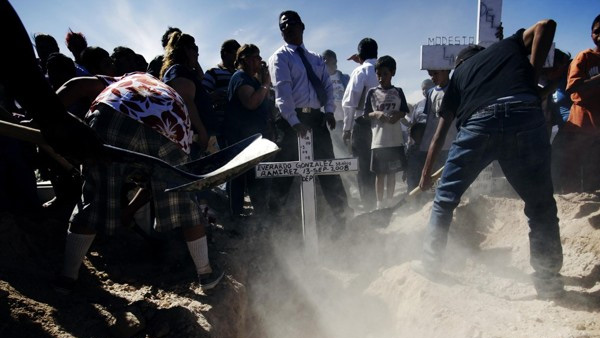
Relatives shovel dirt over the coffin of Eduardo Gonzalez Ramirez during his burial in a cemetery in Ciudad Juarez, Mexico. (Rodrigo Abd/Associated Press)
OJINAGA, Mexico — This rough little border town in the middle of nowhere has seen its share of lawless men, the cocaine cowboys whose wild rides end out in the desert with a shovel of dirt tossed into their shallow graves.
Then the General came to town, and the place went to hell.
Brig. Gen. Manuel de Jesus Moreno Avina, commander of the Third Infantry Company, arrived in the spring of 2008 in Ojinaga, across the Rio Grande from tiny Presidio in Texas’s Big Bend country.
The General, as he is known by all here, quickly began what his own officers described in court testimony as a “reign of terror.”
Instead of confronting organized crime, the Mexican soldiers here quickly became outlaws themselves. Then people began to disappear, according to the charges filed against them.
Now, four years after Moreno’s 18-month tenure in Ojinaga, the landmark case against Moreno and his men may finally change the way Mexico prosecutes soldiers tied to the alleged abusesduring the country’s bloody drug war.
The Mexican Supreme Court recently ruled that Moreno, his officers and two dozen of his soldiers should be tried for human rights crimes in a civilian court — and not as the constitution currently mandates, before a secret military tribunal whose proceedings can take years to go nowhere.
If it happens, such a trial would mark an unprecedented shift of power that could end a century of impunity for Mexico’s armed forces, whose top generals have fought hard to protect themselves from scrutiny.
“What the people want to see after all these years is a real trial,” said Ariel Garcia, a physician in Ojinaga. “It is not right that someone who was sent to protect the people did the exact opposite.”
The doctor said he knows what is he talking about. While he was at the hospital performing surgery in 2008, his house, like many others here, was ransacked by troops in a fruitless search for weapons and drugs.
“When we saw these soldiers, we were not only afraid,” Garcia said. “We were ashamed at what they had become.”
A string of embarrassments
The Supreme Court needs to rule on at least five cases involving military jurisdiction before a precedent is established and a change in the constitution is possible.
It has already sent three cases to civil courts, including one that dates to 1974, when a community activist was stopped a military checkpoint in the western state of Guerrero and never seen again.
The actions follow a string of embarrassing arrests of military officials.
Read more at The Washington Post
We invite you to add your charity or supporting organizations' news stories and coming events to PVAngels so we can share them with the world. Do it now!
Celebrate a Healthy Lifestyle
 From activities like hiking, swimming, bike riding and yoga, to restaurants offering healthy menus, Vallarta-Nayarit is the ideal place to continue - or start - your healthy lifestyle routine.
 Banderas Bay offers 34 miles of incomparable coastline in the states of Jalisco and Nayarit, and home to Puerto Vallarta and Riviera Nayarit's many great destinations.