
| Researchers Find Stalagmite Clues Tell Tales of Mayans' Demise The Province | |
| go to original November 10, 2012 |
 |
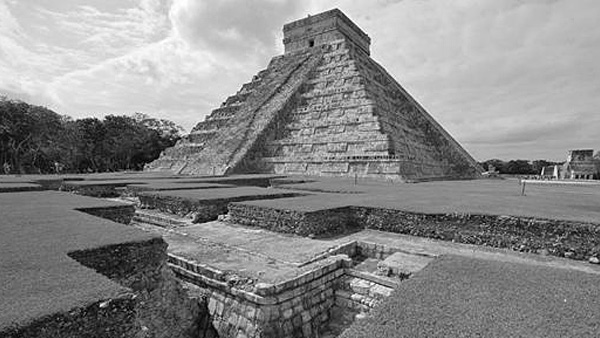
The Mayan civilization originated around 2600 BC in what is now southeastern Mexico. The Kukulcan temple was built by the Mayan in the Yucatán Peninsula. (AFP/Getty Images)
The mystery of the ancient Maya downfall might be solved by a rock formation that suggests climate change could have led to the civilization's demise.
Researchers from Pennsylvania State University traced a climate trail recorded in a 2,000-year-old stalagmite found in a cave in Belize, concluding that prolonged periods of drought corresponded with the disintegration of the Maya political system. The findings are published in the journal Science.
The Maya, who originated around 2600 BC in current-day southeast-ern Mexico, grew to prominence and size during the next three millenniums, building temple step-pyramids and developing highly accurate astronomical and calendar systems. Why some of their larger cities were abandoned a thousand years ago is largely a mystery. Though weather shifts have been proposed previously, the stalagmite findings may offer the data that was lacking, said Douglas Kennett, the lead study author.
"We lucked into very good material to work with, to develop a very detailed climate record that is anchored chronologically in a way that other records haven't been able to," said Kennett, a professor of anthropology at Penn State in State College.
Previous climate records, taken from lake bed samples, would have provided a picture of rainfall levels in 10-year to 30-year increments, with potential errors as much as a century off.
Kennett and his team located the 2,000-year-old stalagmite in Belize's Yok Balum Cave, about one kilometre away from Uxben-ka, a major Mayan site, that recorded rainfall records within six-month increments and with errors within a decade. Stalagmites form when mineral deposits drip down from stalactites, the icicle looking formations that descend from the cave's ceiling. These deposits contain oxygen isotopes that reflect rainfall amounts above the cave, according to the study.
The researchers then matched those findings with a timeline of events from Mayan stone monuments and carvings that were highly detailed in recounting the society's history. The scientists found that a wetter period corresponded with an increase in food production, and population growth, from 450 to 660 AD. During this time, cities such as Tikal, Copan and Cara-col expanded, and the ancient civilization reached the pinnacle of its power, covering all of Guatemala, Belize, parts of Honduras, El Salvador and Mexico.
A drying period occurred during the next four centuries, punctuated by droughts. Mayan records show an increasing number of wars being fought in this period, and eventually larger cities gave way to smaller settlements, Kennett said.
"You have a loss of a large number of these polities," he said. "You get this major reduction in the production of these stone monuments - that's a reflection of kings losing control and losing power at these primary centres."
The final blow came with a 90-year drought that started in 1010 AD, leading to the decline of the last of the major Mayan centres.
Rosemary Joyce, an archeology professor at the University of California, Berkeley, who didn't work on the study, said the information will be valuable.
"Anything that produces an annual, or a very fine grained record that allows us to monitor indirectly the broader climate, is going to help us get a better model," Joyce said. "In that sense, this is important research."
We invite you to add your charity or supporting organizations' news stories and coming events to PVAngels so we can share them with the world. Do it now!
Celebrate a Healthy Lifestyle
 From activities like hiking, swimming, bike riding and yoga, to restaurants offering healthy menus, Vallarta-Nayarit is the ideal place to continue - or start - your healthy lifestyle routine.
 Banderas Bay offers 34 miles of incomparable coastline in the states of Jalisco and Nayarit, and home to Puerto Vallarta and Riviera Nayarit's many great destinations.