
| Greenpeace: US Tried to Cover-Up Effects of BP Gulf Oil Spill Yulia Monakhova - RUVR | |
| go to original October 26, 2012 |
 |
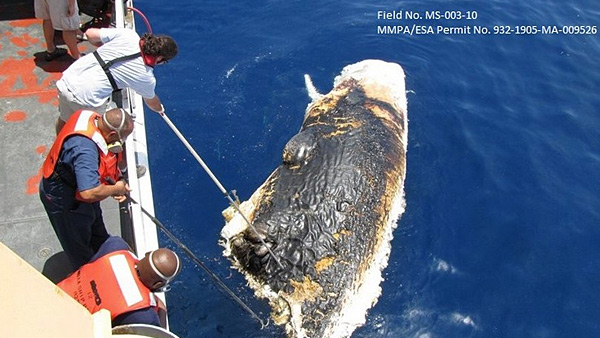
Photographs of a dead sperm whale found in the Gulf of Mexico a few weeks after the BP Deepwater disaster have reignited a debate as to the extent of the oil spill damage and the lasting consequences of the ecological tragedy. (Greenpeace)
Greenpeace obtained documents relating to the 2010 BP oil spill indicating that Obama administration officials tried to restrict information about whales and other wildlife affected by the disaster. The newly released pictures and emails show that, two years ago, the U.S. government tried to cover up the number of whales which came into close contact with BP’s leaking oil well after the Gulf of Mexico spill.
The environmental organization obtained the pictures and emails in late September through a Freedom of information request. The pictures were taken in the summer of 2010 and show the carcass of a sperm whale whose skin had been burnt black. According to The Guardian, the dead whale was sighted at sea, south of the Deepwater Horizon oilrig.
It is thought the photos were taken by crewmembers of the National Oceanic and Atmospheric Administration’s (NOAA) research vessel, Pisces, who found the dead whale on June 15, 2010. It was floating 77 miles from the Deepwater Horizon. The young sperm whale’s skin had been burned and partially eaten by sharks. On the same day, NOAA observers aboard another vessel spotted five whales covered in oil. After the decomposed carcass was discovered, U.S. officials gave strict instructions to the crew aboard the vessels that no information or photographs were to be released. NOAA did later issue a press release about the dead whale, though it was soon edited in such a way that it appeared to minimize the oil’s effect on whales.
There were believed to be about 1,200 sperm whales in the Gulf of Mexico at the time of the spill, making it one of the biggest populations in the world. Environmental organizations and the U.S. government still need to determine the exact impact of the oil spill on wildlife in the area, particularly on endangered species, such as sea turtles and sperm whales. The outcome may have enormous financial implications for BP.
This might be one reason that the oil company recently asked a judge in New Orleans to finalize its settlement for economic damages caused by the Gulf spill. BP estimates that the final cost of reparations will be in the order of $7.8 billion, though the company still has to face claims for environmental damages, and account for wildlife killed as a direct result of the spill.
We invite you to add your charity or supporting organizations' news stories and coming events to PVAngels so we can share them with the world. Do it now!
Celebrate a Healthy Lifestyle
 From activities like hiking, swimming, bike riding and yoga, to restaurants offering healthy menus, Vallarta-Nayarit is the ideal place to continue - or start - your healthy lifestyle routine.
 Banderas Bay offers 34 miles of incomparable coastline in the states of Jalisco and Nayarit, and home to Puerto Vallarta and Riviera Nayarit's many great destinations.