
| American Farmers Flourish in the Fields of Mexico Antoine Abou-Diwan - Imperial Valley Press | |
| go to original October 21, 2012 |
 |
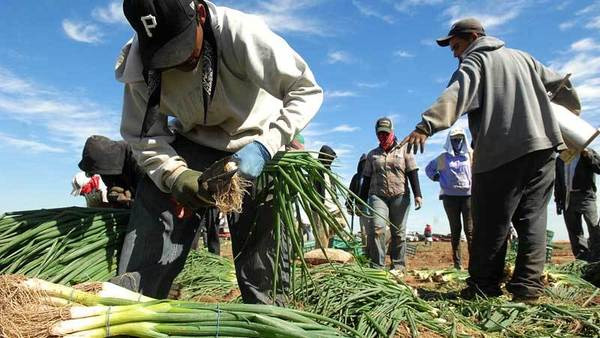
Field workers harvest green onions Wednesday afternoon on Larry Cox's farm south of Mexicali. (Fernando Acosta Jr)
Vegetable farmer and packer Steve Scaroni has two words for people who cling to the idea that American produce is the best.
“Wake up.”
Between vegetable production and trucking, Scaroni has been in business for 25 years. Increasingly frustrated with a regulatory environment that he described as hostile, immigration policies that are out of touch with reality and the desire to diversify his operation, Scaroni ventured into international business. He expanded his business into Guanajuato in central Mexico.
Scaroni is hardly the first American farmer to seek better opportunities on the other side of the border.
“American farmers have been going to Mexico for as long as I can remember,” said Tom Nassif, president and chief executive officer of Western Growers, a crop industry trade association.
“It seems to be cyclical,” Nassif said. “They go over there for a while because they have trouble getting labor. They go over there and have some success. The regulatory environment isn’t as strict.”
Chronic labor shortage was one of the reasons Scaroni invested in Mexico.
“I’m uneasy about the lack of a stable migrant labor supply,” he said. “We have to have a meaningful immigration solution. Legal or illegal — we are consistently short.”
How short? Scaroni said his U.S. operation is consistently short of labor by about 10 percent.
“We’re consistently working 10-hour days,” he said. “What we’re doing is not sustainable.”
Scaroni is quick to debunk the notion that doing business in Mexico is cheaper.
Farming is, by nature, a seasonal activity. Farmers plan their crops according to the season, weather conditions and soil conditions, and hope that extreme weather does not wipe out their investment.
“You go to Mexico to diversify geographical risk,” Scaroni said. If extreme weather destroys his crops in the Imperial Valley, he has his fields in Mexico to fall back on.
Why aren’t more farmers rushing to do business in Mexico?
‘Not for the faint of heart’
Simply put, it’s not easy.
“I got humbled,” Scaroni said. “I misestimated the cultural battle I would fight.”
Scaroni said his staff in Mexico did not work with a sense of urgency that is typical in American business. He described a “mañana” approach to work, where if it doesn’t get done today, it can wait for tomorrow. Maybe.
“Startup was extremely difficult; working against a culture that doesn’t lend itself to ‘just in time’ production,” he said. “There was a lack of a sense of urgency.”
Brawley farmer Larry Cox agrees.
“Productivity is not as good (as in the United States) here,” he said.
Cox’s catalyst for expanding into Mexico was the North American Free Trade Agreement, a trade agreement among Canada, the United States and Mexico which liberalized trade among the three countries.
“I lobbied against NAFTA,” Cox said. “I was concerned about competing with low-cost (labor).”
Cox grows, harvests and packs green onions, asparagus, celery, cauliflower and leeks on about 2,000 acres some 30 minutes south of Mexicali. And befitting the ease with which goods and services are traded across borders, many of his crops are planted in the United States before they are transplanted to his fields in Mexico. He started his Mexican operations on 150 acres.
“I asked myself ‘how much money can I afford to lose,’ and divided by three,” he said.
He initially invested $100,000 per year over three years into his venture in Mexico.
“I didn’t anticipate how much capital it would take to do things the right way,” Cox said. “I found myself stretched financially. It’s hard to know when it’s wise to stop and change direction.”
Cox said he should have doubled his initial investment.
Scaroni said starting up his operation in Mexico took four to five times more capital than he anticipated.
“Mexico is a tough deal,” he said. “It’s not for the faint of heart.”
Both farmers said their operations in Mexico have stabilized, and agree that expanding into Mexico was a good decision. Cox takes advantage of Mexico’s lower labor cost to focus on crops that are more labor-intensive. He has branched out into vegetable packaging and is in the process of expanding his packing shed. But things are still far from perfect. Cox doesn’t have a fixed planting schedule because Mexico is chronically short of water.
“There was no water in August last year,” he said.
The fruits of Scaroni’s and Cox’s investments in Mexico end their journeys on supermarket shelves and dinner tables in America. Both said the majority of their produce gets shipped into the United States.
Scaroni’s venture into central Mexico meant substantial savings on freight.
“I’m closer to East Coast markets,” he said. “The cost to the border (Laredo, Texas) from central Mexico is about the same as out here, but I’m halfway across the country,” he said.
Staff Writer Antoine Abou-Diwan can be reached at aabou-diwan@ivpressonline.com
We invite you to add your charity or supporting organizations' news stories and coming events to PVAngels so we can share them with the world. Do it now!
Celebrate a Healthy Lifestyle
 From activities like hiking, swimming, bike riding and yoga, to restaurants offering healthy menus, Vallarta-Nayarit is the ideal place to continue - or start - your healthy lifestyle routine.
 Banderas Bay offers 34 miles of incomparable coastline in the states of Jalisco and Nayarit, and home to Puerto Vallarta and Riviera Nayarit's many great destinations.