
| Carlos Slim: A Closet Philanthropist or is He Just Plain Stingy? Adam Thomson - The Financial Times | |
| go to original October 16, 2012 |
 |
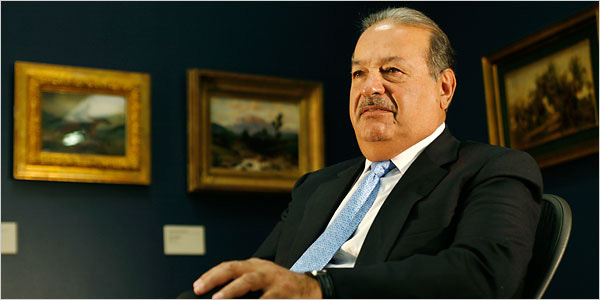
Carlos Slim Helú in his art gallery down the hall from his Mexico City office. He may be trying to soften his image. (Adriana Zehbrauskas/New York Times)
Over the years, Carlos Slim, the Mexican billionaire and the world’s richest individual, has had an ambiguous relationship with philanthropy. When asked in 2007 why he had not done more of it, and earlier, he replied, “I was too busy working.”
More recently, and since rising to the top of the Forbes Billionaires List – as of March, the 72-year-old had a net worth of $69bn, $8bn more than Bill Gates – he said he disagreed with people “who went around like Santa Claus”.
Comments of this sort have earned him, among some quarters, a reputation for believing solely in hard work and achieving things by yourself. Yet, at the end of last month, Mr Slim was in New York receiving a Clinton Global Citizen award from the former US president for “leadership in philanthropy”.
So, where is the truth? Is he a closet philanthropist or is he just plain stingy?
Perhaps to the surprise of many, Mr Slim appears to be doing a lot. According to his holding company, Grupo Carso, the Carlos Slim Foundation and his Telmex Foundation are worth about $8bn in combined endowments – big by any measure.
Arturo Elias Ayub, director of strategic alliances at Telmex, Mr Slim’s fixed-line telephone company, says that the foundation has $6bn of the total – money that he says the telecoms billionaire handed over from taxed earnings.
Among many other things, the foundation has provided Mexicans with more than 128,000 pairs of reading glasses, 293,000 bicycles for children who live far from their schools, 245,000 scholarships and 794,000 medical operations.
Mr Elias Ayub says about 85 per cent of the foundations’ projects centre on health and education – two areas of human development that crop up constantly in Mr Slim’s discourse on solving poverty.
Last week, the Telmex Foundation sponsored this year’s Homeless World Cup, an annual event in which the organisers use football to bring about psychological change in homeless people around the world, then get them to use their experience to return to their communities and become role models for others.
Adolfo Vega Fernandez, a 21-year-old from the central Mexican state of Zacatecas, is one of them He is representing Mexico in the event, which is being played in the Zocalo, Mexico City’s main square. But he says that, had it not been for football, he would probably have a very different life. “This has taught me that the street isn’t everything,” says the tall and skinny Mr Vega Fernandez. “I’ve started to take up studies again and, once the tournament is over, I want to go back home and get others involved.”
Jorge Villalobos, executive vice-president of the Mexican Centre for Philanthropy, describes Mr Slim’s philanthropic endeavours as “amazing ... I don’t know any other foundation in Mexico that comes even remotely close to the size of Mr Slim’s,” he says.
But he also admits that the telecoms magnate has a very particular style. “He doesn’t have a foundation that donates money,” he explains. “It is more of an operating foundation.” Indeed, the Telmex Foundation executes many of its projects rather than the more typical process in the US of grant-making.
That approach fits squarely with the fact that Mr Slim is given to doing things in his own way. As Mr Villalobos says: “He likes to solve problems.”
Experts say that is understandable in a country where the culture of philanthropy is still evolving. According to an investigation by the US-based Johns Hopkins Comparative Nonprofit Sector Project, private donations to the country’s not-for-profit sector are equivalent to a mere 0.04 per cent of the country’s roughly $1tn GDP.
That is about 40 times lower than in the US, and the lowest in the 2003 Johns Hopkins study of 35 developed and developing countries. Other states in the region, such as Brazil and Colombia, give much more on a proportional basis.
As a result, there are relatively few organisations with the know-how and experience to execute philanthropic projects efficiently and on the sort of scale that Mr Slim’s foundations would permit.
But Michael Layton, who works at the philanthropy unit of Mexico City’s Itam university, says Mr Slim’s relative lack of grant-making severely limits the potential impact his foundations could have in Mexico – a country in which almost half the population lives below the poverty line.
“The Bill & Melinda Gates Foundation has made a huge impact on Aids, and it has done so through grant-making,” Mr Layton says.
“If you don’t do that, the money just tends to sit there.”
We invite you to add your charity or supporting organizations' news stories and coming events to PVAngels so we can share them with the world. Do it now!
Celebrate a Healthy Lifestyle
 From activities like hiking, swimming, bike riding and yoga, to restaurants offering healthy menus, Vallarta-Nayarit is the ideal place to continue - or start - your healthy lifestyle routine.
 Banderas Bay offers 34 miles of incomparable coastline in the states of Jalisco and Nayarit, and home to Puerto Vallarta and Riviera Nayarit's many great destinations.