
| Protestants on the Rise as Pope Visits Mexico Ioan Grillo - Reuters | |
| go to original March 22, 2012 |
 |
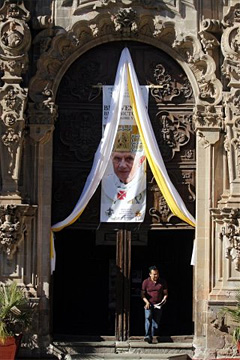 |
| A man leaves a church in the Mexican city of Guanajuato decorated with a poster welcoming Pope Benedict XVI on March 20, 2012. (EFE) |
LEON, Mexico - Worshippers jumping about in church, waving their hands to the swell of keyboards and electric guitars is not a sight any pope would hope to find in Mexico, for long one of the world's most devout Roman Catholic countries.
But when Pope Benedict visits the city of Leon in Mexico's Catholic heartland this weekend, the growing strength of Protestant groups will be on view just hundreds of meters from where he will meet with bishops and the Catholic faithful.
The leader of the world's 1.2 billion Catholics arrives in Mexico to find a Church struggling to keep its flock.
Over the last decade, the number of Catholics leaving the fold has posted its biggest surge in modern Mexican history as more and more put their faith in evangelical Protestantism or the book of Mormon, or turn away from religion altogether.
At one evangelical service in Leon this month, worshippers yelled out to banish their demons in a style reminiscent of the U.S. Bible Belt. Hymns were backed by rock guitars, the faithful leaped up and down and an elderly woman added to the music by blowing through an enormous curved animal horn.
Some say they are attracted to the evangelical services because they are more exciting than solemn Catholic masses.
Others say they have been turned off Catholicism by child abuse scandals, which have hit several dioceses in Mexico in recent years.
The Church's problems in Mexico reflect a broader decline across much of Latin America. Brazil and Mexico are the world's most populous Catholic countries.
Juan Pablo Barrera, a 32-year-old leather trader from Leon, says he left the Catholic faith two years ago because evangelicalism touched him more deeply, and that his new beliefs have helped him deal with anger and become a better father.
"The Catholic Church never taught me to have a personal relationship with God," Barrera says. "It told me that the pope, the Virgin, the saints and the priests were more important."
Even among the Catholic majority, many are also breaking the rules of Rome. Only about half of Mexican marriages are blessed by the Catholic Church, according to government records, and birth control is widespread.
Liberal social policies have gained ground despite Church opposition with both abortion and gay marriages now legal in Mexico City.
And in a country ravaged by a drugs war that has killed about 50,000 people in the last five years, hundreds of thousands of Mexicans who consider themselves Catholic today venerate a female skeletal grim reaper known as Santa Muerte, or "Holy Death", despite objections from their priests and bishops.
'HISTORIC CHANGE'
More than 99 percent of Mexicans professed to be Catholics when Mexico held its first modern census in 1895 and even by 1970, 96 percent still pledged allegiance to Rome.
But that dropped to 88 percent by 2000 and then to 82.7 percent in 2010 - the sharpest decline since the census began.
"This is a moment of historic change in religious beliefs in Mexico," says Elio Masferrer, an expert on growing religious diversity. "If this trend continues, there will be some Mexican states where the majority are not Catholic by 2020."
The decline is all the more remarkable given that since 2000, Mexico has been ruled by the socially conservative National Action Party, or PAN, which has traditionally had a strong Catholic identity.
The PAN ended 71 years of rule by the Institutional Revolutionary Party, which was born of the Mexican revolution and at times repressed the Church.
Vicente Fox, the first PAN leader to become Mexican president, celebrated his faith and kissed Pope John Paul II's ring during a papal visit in 2002.
The current president, Felipe Calderon, also publicly attends church services and will meet Benedict on this visit to rally Mexico's Catholic faithful.
But even the PAN has had to respond to changing times among its own supporters, says Luis Felipe Bravo, the party's former chairman and once Mexico's ambassador to the Vatican.
"We have a very large number of activists who belong to evangelical churches or who don't have any religious beliefs," Bravo told Reuters. "It's part of the face of modernity."
Within this, atheists now count for 4.6 percent of Mexicans, and are particularly influential in the capital, where a leftist government promotes birth control and gay rights.
Guanajuato, where Benedict will ride in the pope-mobile and conduct a huge outdoor, remains Mexico's most Catholic state, with almost 94 percent following the faith.
Built around silver mines of the Spanish empire and thriving industry today, Guanajuato is largely free of the drug violence plaguing much of Mexico, easing the pontiff's security concerns.
Even here, though, the number of Protestants has doubled in the last decade, and in Leon alone there are now more than 130 registered groups of evangelical Christians.
PLANTING SEEDS
While many are small flocks of 50 to 100 people who hold services in rented spaces, some have huge congregations.
The "Trigo y Miel" or "Wheat and Honey" association holds Sunday services for about 1,000 faithful in a converted shoe factory in a working class Leon neighborhood.
We invite you to add your charity or supporting organizations' news stories and coming events to PVAngels so we can share them with the world. Do it now!
Celebrate a Healthy Lifestyle
 From activities like hiking, swimming, bike riding and yoga, to restaurants offering healthy menus, Vallarta-Nayarit is the ideal place to continue - or start - your healthy lifestyle routine.
 Banderas Bay offers 34 miles of incomparable coastline in the states of Jalisco and Nayarit, and home to Puerto Vallarta and Riviera Nayarit's many great destinations.