
| Mexico City Gives Its Historical Center a Makeover Sergio Ramos - Infosurhoy.com | |
| go to original October 3, 2012 |
 |
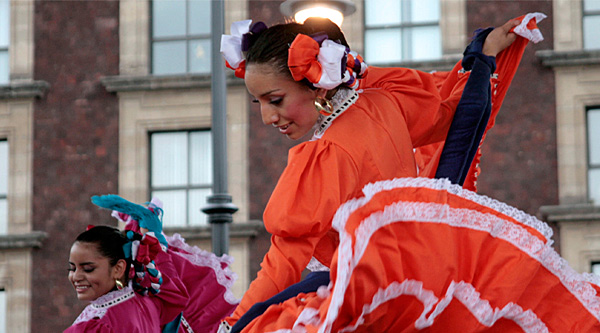
Students from the Mexican Dance Academy perform in the Mexico City’s main square, the Zócalo, showcasing regional folkloric dances, part of the Cultural Corridors program the city’s Historic Center Rescue Trust has organized to entertain residents. (Courtesy of Mexico City government)
MEXICO CITY – “It’s the best thing they’ve done in this city.”
That’s how Ángel González, a 62 year-old restaurateur in the center of Mexico City, describes the work done to rescue the historical heart of the Mexican capital – declared a World Heritage site by the United Nations Educational, Scientific and Cultural Organization (UNESCO) in 1987 – from the blight posed by crime, homelessness, and poverty.
“Some years ago there was a lot of crime in the center,” he said. “Now, people walk around all hours, whereas before nobody was left in the street after 8 p.m.”
The restoration was possible thanks to the Historic Center Rescue Trust, which since 2002 has gathered citizens, business and government leaders to promote and coordinate the execution of public works and services toward the recovery and conservation of Mexico City’s historical center.
Since then, numerous initiatives have occurred to improve public spaces, turning this part of town into the cultural, touristic, social, and economic hub of this city of 21 million, according to Inti Muñoz, the trust’s general director.
“We want citizens to regard the city center as our cultural patrimony,” he said. “We want them to see it as an expression of pride – not as a city-museum. We want it to be viewed as a living organism, with many things to offer, with many stories to tell.”
Immediately after being convened, the trust divided the 668 city blocks (3.5 square miles) that make up the city center into seven areas, the first step in the urban renewal plans.
The repair and restoration work consisted of:
- Fixing facades, including the cleaning of walls; new paint; and polishing marble surfaces;
- New regulations regarding billboards, awnings and appliances in public areas that don’t detract from the original architecture;
- Repairing lighting fixtures and underground wiring;
- Cleaning of shrubberies and gardens in the public plazas, where plants lacked proper care;
- Providing new forms of transportation, including eco-bicycles, cycle-taxis, and electric taxis.
Currently, work is being done in the section that goes from the Lázaro Cárdenas Central Axis up to the boulevard Paseo de la Reforma, a section that includes such emblematic attractions as the Bellas Artes palace and Alameda Central Park.
In the Alameda Central Park, originally built in 1590, there was evident deterioration from waste being dumped by the 375 street vendors who occupied the area, along with broken streetlights and poorly tended greenery.
Nonetheless, efforts to remove street merchants from the historical center have been met with considerable resistance.
On July 12, 25 vendors who sold pirated products on the streets of the Central Axis were arrested after a confrontation with the police because the government, for the first time in many years, tried to free up sidewalks for the exclusive use of pedestrians.
Since then, the sidewalks along the Central Axis and Alameda are under permanent watch by authorities to prevent the street vendors from setting up shop again in the city center.
The refurbishment of the 26.7 acres (10.8 hectares) that make up the oldest park in the Americas included the restoration of sculptures, the widening of sidewalks and constructing new walkways lined with stone, according to Mexico City Mayor Marcelo Ebrard.
“The people who have a right to public space are citizens,” he said. “This is the first modern human right – to be able to use parks and public spaces.”
Tourists are especially pleased with the effort. “It’s incredible what they’ve done in the center,” Bernardo Villalobos, 47, said during a recent visit to the historical center with his family.
Villalobos left the Mexican capital 20 years ago to live in Guadalajara, precisely to get away from crime.
“Before, one would walk the streets in fear because there were many robberies and they’d take off with even your shoes,” he added.
Now, things are different.
“The city’s being unsafe is more of a legend [than fact],” said Carlos Rubio, a 25-year-old tourist from Monterrey. “What’s more, considering all that’s happening lately in Nuevo León, you find here an atmosphere of peace and security that regrettably has been lost in the northern part of the country.”
Guide and cultural corridors
To promote the renewal of the historical center, the trust published a guide on the Internet that lists a comprehensive catalogue of museums, restaurants, plazas, shops, hotels and churches worth visiting, Muñoz said.
“The website is a new way for someone to understand the city center, with interactive maps, images, texts, and videos that for the first time gather in one place everything that the historical center is and all that happens there,” he said.
The website was possible thanks to input by historians, anthropologists, chroniclers, social journalists, photographers and video-artists, Muñoz said.
Another one of the projects is the Cultural Corridors program, which since July has offered open-air shows free of charge by theater groups, the Mexican Dance Academy and musicians from several countries of Latin America, according to Nina Serratos, Secretary of Culture for the Federal District.
“One of the project’s goals is to offer a public stage for talented artists who are not part of the commercial circuit and who would otherwise have few possibilities of reaching a mass audience,” she said.
The first of four Cultural Corridors is taking place along the Madero pedestrian walkway and is expected to run through December.
The goals are to encourage the sense of community among citizens, reconstruct the social fabric and foster a sense of security, Serratos said.
We invite you to add your charity or supporting organizations' news stories and coming events to PVAngels so we can share them with the world. Do it now!
Celebrate a Healthy Lifestyle
 From activities like hiking, swimming, bike riding and yoga, to restaurants offering healthy menus, Vallarta-Nayarit is the ideal place to continue - or start - your healthy lifestyle routine.
 Banderas Bay offers 34 miles of incomparable coastline in the states of Jalisco and Nayarit, and home to Puerto Vallarta and Riviera Nayarit's many great destinations.