
| Mexico Joins Group to Promote Linguistic Diversity, Communications EFE | |
| go to original September 30, 2012 |
 |
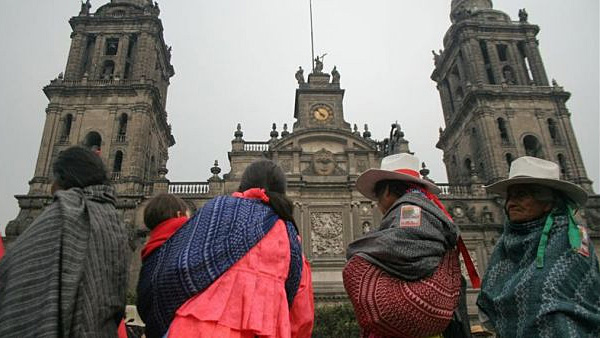
Indigenous women walking next to the Metropolitan Catedral at Mexico City. (EFE)
MEXICO CITY -Mexico will join the World Network for Linguistic Diversity in order to promote intercultural education and communications, as well as to strengthen individual languages, The National Institute of Indigenous Languages, or Inali, said.
This department of the Education Secretariat said in a communique that the country also plans to take part in the Latin American Network for Multilingual Intercultural Cooperation.
The announcement was made Friday by Inali Director General Javier Lopez Sanchez during the closure of the 2nd International Seminar on Indigenous Languages, where he said that these two organizations specialize in “promoting intercultural and multilingual education and communications by means of works based on the mother tongue.”
At the same time he said that the invitation to become members of those organizations came from their respective directors, Adama Samassekou of Mali and Ramiro Dominguez Codas of Paraguay, both present at the event.
Lopez invited the participants in the seminar, entitled “Indigenous Peoples, Linguistic Rights and the Professionalization of Interpreters in Multicultural and Multilingual Contexts,” to put technological instruments at the service of languages so that Mexico’s cultural and linguistic diversity be made known worldwide.
“In the so-called information society of the 21st century, it is essential that we don’t forget our original identity. It would be wonderful to really think in terms of a multilingual, multicultural society,” the official said.
The World Network for Linguistic Diversity, created in the context of the World Summit on the Information Society in Geneva 2003-Tunis 2005 and whose members include the United Nations Educational, Scientific and Cultural Organization, or UNESCO, is an exchange platform whose mission is to evaluate and promote linguistic diversity as the basis of human communications.
For its part, the Latin American Network for Multilingual Intercultural Cooperation is a cultural-educational body whose signatory nations are Bolivia, Ecuador, Peru and Paraguay, with Argentina and Colombia currently taking steps to join.
In Mexico, 15.7 million people - 14 percent of the population - consider themselves indigenous, but of those only 6.6 million speak any of the 364 dialects of the country’s 68 existing languages, Inali said.
We invite you to add your charity or supporting organizations' news stories and coming events to PVAngels so we can share them with the world. Do it now!
Celebrate a Healthy Lifestyle
 From activities like hiking, swimming, bike riding and yoga, to restaurants offering healthy menus, Vallarta-Nayarit is the ideal place to continue - or start - your healthy lifestyle routine.
 Banderas Bay offers 34 miles of incomparable coastline in the states of Jalisco and Nayarit, and home to Puerto Vallarta and Riviera Nayarit's many great destinations.