
| DF Art Exhibition Explores the Meaning Behind the Machete Steven P. Nichols Jr. - The News | |
| go to original March 21, 2012 |
 |
 |
| “Una historia de machetes” will remain open to the public through April 26 in the Melquiades Herrera Gallery at the Ex Teresa Arte Actual Museum. For more information on the exhibition, visit the museum’s website |
The machete has many uses – the iconic tool of residents of tropical countries has proved indispensable in the lives of those who depend on it. It’s used to navigate through dense foliage, cut fruits and vegetables, trim domestic trees and plants and for personal defense or aggression. The tool has been used countless times as a symbol of Latin America, even making its way into Hollywood as the title of Robert Rodriguez’s 2010 comedy about Mexican gangsters. That’s why it’s not entirely surprising that the machete is the object of the Ex Teresa Arte Actual Museum’s latest exhibition, “Una historia de machetes” (“A History of Machetes”).
Don’t be fooled by the name – this exhibition, created by Manuel “Mike” Rodríguez Sepúlveda and inaugurated last Thursday, doesn’t delve into the actual history of the machete nor does it educate visitors on blade sizes or handle fittings. Instead, it takes advantage of the tool’s varied uses to provoke a discussion on physical and philosophical transformation – something of particular interest to Rodríguez Sepúlveda.
“Over the previous several years I have become more interested, artistically speaking, in the contexts in which I find myself and the phenomena that I experience,” Rodríguez Sepúlveda said. “I typically express these phenomena in scientific and mathematical terms, drawing parallels between scientific theories and events which occur on a daily basis, such as violence.”
In this case of this exhibition, which features as its main attraction a series of 100 machetes suspended in the air, 5 centimeters apart from each other, with a fan which causes the machetes to make contact with each other and creates a wind chime-type effect, Rodríguez Sepúlveda chose to take up the law of conservation of energy.
“The idea for me in this part of the exhibition is transformation,” Rodríguez Sepúlveda said. “The machete isn’t only used as a utilitarian tool, for cutting back brush or chopping up fruit, but at critical moments, it’s also transformed into a weapon of war – a weapon often used by rural peoples to stage uprisings or to protect themselves.”
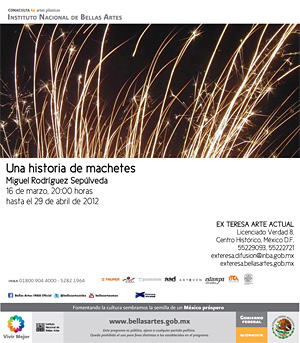
The idea to use machetes for this phenomenon came after Rodríguez Sepúlveda staged a video exhibition in November, which is now featured in the exhibition, in which he had three people sharpen machetes in a dark room. Each sharpener was equipped with a “stencil” of sorts which, when penetrated by the light generated by the sparks from the sharpening process, projected the words “Viva méxico, cabrones!” (“Love live Mexico, comrades”), a patriotic proclamation often heard during events celebrating the Mexican Revolution.
“This idea of transformation even goes further than just the idea of the machete as a tool for the Mexican revolution, a change of government,” Rodríguez Sepúlveda said. “But we also took those three machetes used in the video exhibition, which were sharpened down basically to a nub, and integrated them into “Una historia de machetes” as another symbol of transformation.”
This isn’t the first time Rodríguez Sepúlveda has dealt with the concept of the law of conservation of energy – in 2010, in celebration of the 200th anniversary of Mexico’s independence from Spain, the artist inaugurated his exhibition “Serie Plata Libertad” (“Freedom Silver Series”) at the University Contemporary Art Museum (MUAC) in which he scrubbed 200 commemorative silver coins onto a series of sheets of paper, forming a gigantic wall of reflective silver rectangles.
“Apart from just having monetary value, these coins also represent the transformation of Mexico from a colony to a sovereign country…these coins tell this story,” Rodríguez Sepúlveda said. “But we, as users of these coins, only receive this message – we don’t tell it. That’s what I found interesting about the exhibition – the silver sheets of paper, while not 100% reflective like a mirror, projected the image of the person who was viewing them – someone who is also a product of Mexico’s independence, they tell a story just like the coins did before they were transformed.”
Rodríguez Sepúlveda, who grew up in Veracruz and has studied architecture, photography and fine arts, said that the production of these projects, which required the use of expensive materials, wouldn’t have been possible if it weren’t for the unique workshop to which the artist belongs – “Taller Multinacional.”
Taller Multinacional, a special artists workshop shared by a number of artists and writers that is located on the 21st floor of the Torre Latinoamericana, has created an innovative non-profit program for financing artistic projects.
The program, titled “Jóvenes Collecionistas” (“Young Collectors”), is based on the concept of “crowd funding” (Networks which allow open investment in projects, mainly business startups) and allows young people interested in art the ability to finance artistic projects in return for art.
“The immediate advantage of this program is the ability to carry out artistic projects without having to depend on bureaucratic institutions,” Rodríguez Sepúlveda said. “But it also serves to get people involved in art – most of my friends from high school ended up being accountants and lawyers and even though they like art, they feel like contemporary art is too conceptual for them and it’s hard for them to truly get involved and understand it. But, when you involve them in the actual process of creating the art, when they are actually invested in the production of an artistic project, they enter into an artistic dialog which becomes easier for them to understand.”
“Una historia de machetes” will remain open to the public through April 26 in the Melquiades Herrera Gallery at the Ex Teresa Arte Actual Museum. For more information on the exhibition, visit the museum’s website at exteresa.bellasartes.gob.mx.
We invite you to add your charity or supporting organizations' news stories and coming events to PVAngels so we can share them with the world. Do it now!
Celebrate a Healthy Lifestyle
 From activities like hiking, swimming, bike riding and yoga, to restaurants offering healthy menus, Vallarta-Nayarit is the ideal place to continue - or start - your healthy lifestyle routine.
 Banderas Bay offers 34 miles of incomparable coastline in the states of Jalisco and Nayarit, and home to Puerto Vallarta and Riviera Nayarit's many great destinations.