
| 'Time in the Mayan Thought' Upcoming Conference Yucatan Times | |
| go to original September 26, 2012 |
 |
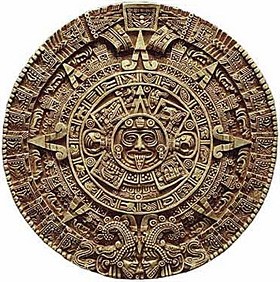 |
Domestic and foreign experts will gather at the conference titled “Time in Maya Thought,” to be held in Merida, Yucatan, on the 27 and 28 September to discuss the system used by the Mayans to count time.
According to information from the National Institute of Anthropology and History (INAH), the symposium will be attended by specialists from INAH, the Center for Maya Studies from the National Autonomous University of Mexico (UNAM), as well as USA Universities from New Mexico, California, Illinois, the New College of Florida and Albany. Outside of the USA and also attending will be the University of Bonn in Germany, and the University of Quintana Roo, among others.
Despite the great advance of Maya epigraphy from mid-twentieth century the study of calendars was set aside, because the researchers focused their attention on genealogy, but now they will retake the chronological documents to reconstruct the thoughts of the Mayas in relation to time, said the archaeologist Alfredo Barrera Rubio.
Barrera Rubio will be the coordinator of the symposium, and highlighted the importance of resuming the study of the Mayan calendar, which flourished in the second half of the twentieth century with investigators from the USA, such as Sylvanus Griswold Morley and British Erick Thompson.
They believed (Griswold and Thompson) that the ancient civilization had an obsession with time, they studied the calendar inscriptions and interpretation and through their contributions they made it possible to date the pre-Hispanic sites in accordance with calendar notations recorded on steles, monuments and other remains found in Maya settlements.
However due to the contribution of the Russian epigraphist Yuri Knorosov in deciphering Maya writing, which was not accepted immediately because of the opposition from Thompson, there emerged a series of interpretations about history, genealogy, alliances of dynasties among other interests that extends to the present, relegating the studies on time counting systems.
The archaeologist Alfredo Barrera explains that currently there is more interest in epigraphy concerning dynastic succession, which addresses the future of the Maya at a more political, social and economic aspects. However, for archaeologists and anthropologists that is not enough, the study of this ancient society involves social, economic and spiritual processes that can provide more information about the Mayans historical development.
The archaeologist Alfredo Barrera will also participate in the symposium with a presentation on some events relating to the social and cultural history of Uxmal, listed in the first Hispanic and indigenous sources of Cologne, requiring a revision in the light of recent research.
In conclusion, he noted that the purpose of the symposium is to stimulate discussion among researchers and enrich the studies on the time between the Maya, especially now that a lot of these ideas have been deformed by people who are not professional anthropological scientists. “After the excitement of alarming reports, we believe that science will prevail,” he said.
We invite you to add your charity or supporting organizations' news stories and coming events to PVAngels so we can share them with the world. Do it now!
Celebrate a Healthy Lifestyle
 From activities like hiking, swimming, bike riding and yoga, to restaurants offering healthy menus, Vallarta-Nayarit is the ideal place to continue - or start - your healthy lifestyle routine.
 Banderas Bay offers 34 miles of incomparable coastline in the states of Jalisco and Nayarit, and home to Puerto Vallarta and Riviera Nayarit's many great destinations.