
| President-Elect Enrique Pena Nieto's Latin American Agenda Johanna Mendelson Forman - VOXXI | |
| go to original September 24, 2012 |
 |
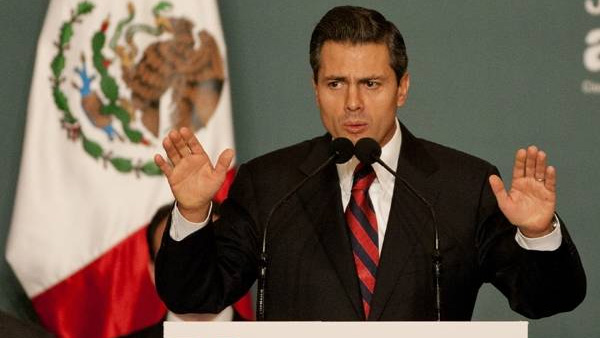
Mexico’s President-elect Enrique Pena Nieto announces a proposed bill for more transparency on government spending in Mexico City, Monday, Sept. 10, 2012. (AP/Eduardo Verdugo)
The six-country Latin American tour of Mexico’s president-elect, Enrique Pena Nieto included visits to Guatemala, Colombia, Chile, Argentina, Brazil and Peru.
While it is not unusual for Latin American leaders to meet counterparts before taking office, this pre-inaugural whirlwind suggests that Mexico’s new leadership may be looking more to the south as well as the north for support in addressing central concerns - fighting crime, strengthening border security, addressing migration issues and seeking new investors to boost economic growth.
On his last stop in Brazil, Pena Nieto sought a reset of his country’s relationship with this economic giant, especially since Mexico has lost its standing as the largest Latin American economy.
Pena Nieto’s travel marked a departure from Mexico’s more insular approach in the region. His meetings underscored a blossoming eagerness to strengthen ties with countries that experience similar challenges without relying on the United States to serve as its interlocutor. This was certainly the case in his visits to Brazil and Argentina, two countries that have had some tensions over economic rivalry.
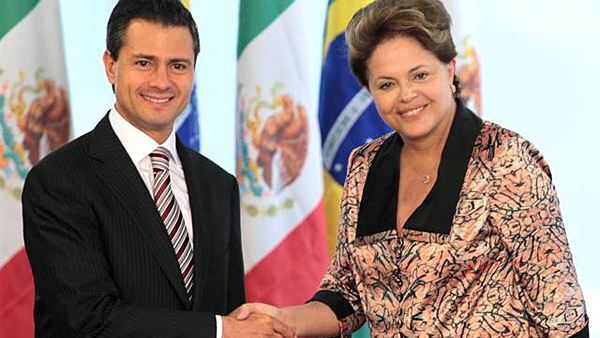
Mexico’s President-elect Enrique Pena Nieto, left, shakes hands with Brazil’s President Dilma Rousseff at the Planalto presidential palace in Brasilia, Brazil, Thursday, Sept. 20, 2012. (AP/Eraldo Peres)
Pena Nieto to make Mexico a facilitator of LATAM
As a Pena Nieto spokesperson noted, the purpose of his trip was to bolster “the position that Mexico has in the region and the possibilities that it has as a country to build itself as a facilitator” in Latin America.
Notably, President Felipe Calderon used such an approach to carve out a leadership role not with the United States nor with the Organization of American States, but with other neighbors in the Americas and new multilateral forums such as CELAC, the 33-member Community of Latin American and Caribbean States.
The Mexican press has characterized this tour as one that will “consolidate a sense of brotherhood in the region.” But this not so subtle agenda also suggests a more deliberate effort to reduce the impact of Mexican dependence on U.S. dominance in security, counternarcotics, and trade matters - especially as Mexico negotiates to become part of the extra-hemispheric Trans-Pacific Partnership.
Notably, he did not visit any of the ALBA countries. Even so, Mexico’s new president seems to be signaling to regional colleagues and countrymen not only that he intends to lead, but also that he is willing to learn from neighbors when he enters Los Pinos on December 1, 2012.
Pena Nieto will need as much help as he can get once he enters office. The ongoing perception of Mexico’s battle against transnational organized crime has affected investor confidence. Yet Mexico’s homicide rate as of 2011 was 18 per 100,000, compared to Brazil’s which was much worse, at 23 per 100,000.
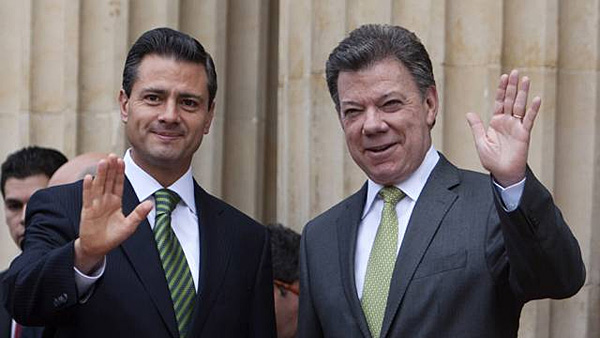
Mexico’s President-elect Enrique Pena Nieto, left, and Colombia’s President Juan Manuel Santos, right, wave at the presidential palace in Bogota, Colombia, Tuesday, Sept. 18, 2012. (AP/William Fernando Martinez)
Certainly this visit may yield some collaboration between both countries about ways to combat urban violence and manage crime. Brazil’s experience in working in the urban slums, or favelas, has also yielded important lessons in management of security, as urban police and the military have created success programs to address violence.
In addition to drug trafficking, Mexico also had groups such as the Zetas, territorial predators that control not only certain parts of the country, but also run the economy in their territory. These criminal groups threaten not only the future economic development of the nation, but also its very young democracy.
As he prepares to assume the presidency after his party’s 12 year absence from power, we may see from this Latin America trip a much broader agenda of regional integration.
Economic competition with Brazil and a desire to put Mexico back into the global game may be the first of many changes in how Mexico’s oldest political party transitions to a more globalized and multi-polar world order. Does Pena Nieto’s international vision hope to add an “M” to the BRIC acronym? This may well be the case in the months ahead.
Johanna Mendelson Forman is a Senior Associate in the Americas Program at the Center for Strategic and International Studies.
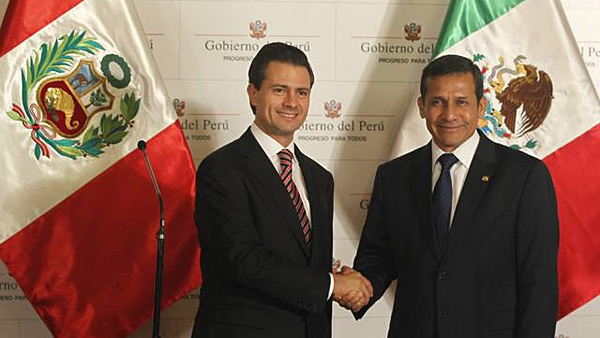
Peru’s President Ollanta Humala, right, shakes hands with Mexico’s President-elect Enrique Pena Nieto as they pose at the government palace in Lima, Peru, Sunday, Sept. 23, 2012. (AP/Martin Mejia)

In this released by La Moneda government palace, Chile’s President Sebastian Pinera, right, poses with Mexico’s President-elect Enrique Pena Nieto in Santiago, Chile, Friday, Sept. 21, 2012. (AP/La Moneda, Hugo Adonis)
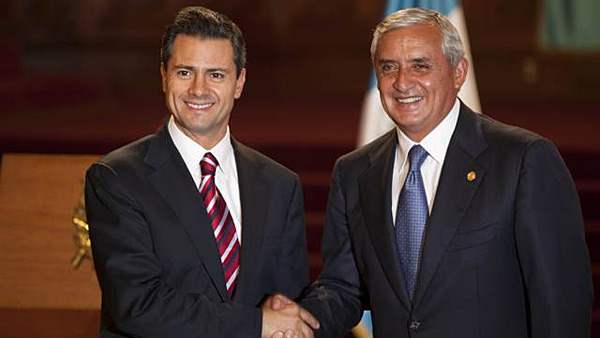
Mexico’s President-elect Enrique Pena Nieto, left, shakes hands with Guatemala’s President Otto Perez Molina as they pose for pictures after a joint press conference at the national palace in Guatemala City, Monday, Sept. 17, 2012. (AP/Moises Castillo)
We invite you to add your charity or supporting organizations' news stories and coming events to PVAngels so we can share them with the world. Do it now!
Celebrate a Healthy Lifestyle
 From activities like hiking, swimming, bike riding and yoga, to restaurants offering healthy menus, Vallarta-Nayarit is the ideal place to continue - or start - your healthy lifestyle routine.
 Banderas Bay offers 34 miles of incomparable coastline in the states of Jalisco and Nayarit, and home to Puerto Vallarta and Riviera Nayarit's many great destinations.