
| The War Against Freedom of Speech Nubia Nieto - Yucatan Times | |
| go to original September 24, 2012 |
 |
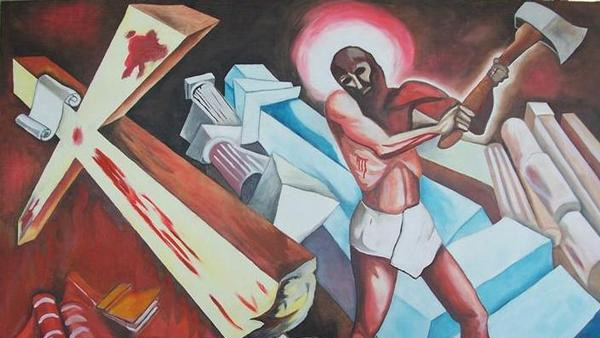
“When José Clemente Orozco painted murals for the National Preparatory School in Mexico City in the early 1920s, one of the most controversial was his Christ Destroying His Cross (above, a different version from 1943). Orozco returned to this theme over and over, including a version in his largest work, the 24-panel, 3,200-square-foot-long series of murals known as The Epic of American Civilization at Dartmouth University. Instead of painting the meek, suffering servant version of Christ, Orozco paints an axe-wielding Jesus chopping down the cross as a symbol of all forms of authoritarian oppression throughout history. Meek acceptance of anything just wasn’t something Orozco could do, and he could never envision a savior who was less of a warrior than he was. It’s amazing to think that Orozco accomplished such tremendous physical feats of art with a single hand and diminished eyesight, but the fires that burned inside his soul fueled a mighty engine that refused to quit as long as someone, somewhere did not enjoy the light of freedom.” ~Courtesy of Art Blog by Bob
The Muslim world has been the centre of the global news, after the release of the film “The Innocence of Muslims”, in which the prophet Mohammed is criticised. Protests in Tunisia, Sudan, Turkey, Libya, Egypt, Indonesia, Iraq, Lebanon, Iran and even inAustralia have been recorded. Anti-west violent demonstrations and attacks on embassies have resulted in dozens dead and the killing of the USA ambassador to Libya, Chris Stevens, along with three other USA consulate staff in Benghazi.
The violent protests in the Muslim world over an anti-Islam film made in the USA, reveal not only that the freedom of speech is far away from being reached in the Middle East, but also shows how dangerous it is to install this freedom of speech in some countries. Certainly, talking or expressing religious views is not a simple matter and in history this has never been an easy topic. Confrontations between Protestants and Catholics in the 17th century in Europe were a common phenomenon. And blasphemy against Jesus Christ was punished by the courts with death, imprisonment or corporal punishment from the 16th century to the mid 19th century. Therefore, it was a few centuries before reaching a certain level of religious maturity to assume criticisms and accept secularism – separation of the State from religious rules- in order to live in a civilised society with religious tolerance.
Nowadays, the Middle East is confronted to overcome radicalism and extremisms not only in their laws and political institutions, for example: blasphemy is punishable by the death penalty in some Muslim countries, but also in their mentalities and cultural values.
In Latin America, the freedom of speech seems to be also an important challenge and social aspiration. In the decade of the 1970’s, this freedom was subdued mainly by dictators of the region. Today, in many countries such as Mexico, Guatemala, El Salvador, Honduras, and Colombia, freedom of speech is opposed by organised crime against journalists and human rights defenders. Torture, psychological threats, beheadings, exile and disappearance are the most common crimes in the region.
In Russia, the punk band Pussy Riot has been jailed for two-years for taking part in protests against Russian President Vladimir Putin. At the same time, several journalists have been victims of the authoritarian and repressive methods used by the Putin government in order to control and stop freedom of speech.
In Europe even if the freedom of speech is better that does not mean it is perfect some example are France and the United Kingdom, which supposedly are democratic countries, plan to submit laws to allow monitoring of phone calls, text messages, emails, social networks and other electronic communications by their governments on the premise of combating terrorism and organised crime. However, these measures threaten individual freedom and the freedom of expression of ordinary citizens. In summary, the freedom of expression is an essential value for all democracies around the world and there is not an excuse to censure this value under any circumstances. Religious, political, economic, ideological or criminal interest. It is a value that needs to be preserved at any cost for the well-being of societies.
We invite you to add your charity or supporting organizations' news stories and coming events to PVAngels so we can share them with the world. Do it now!
Celebrate a Healthy Lifestyle
 From activities like hiking, swimming, bike riding and yoga, to restaurants offering healthy menus, Vallarta-Nayarit is the ideal place to continue - or start - your healthy lifestyle routine.
 Banderas Bay offers 34 miles of incomparable coastline in the states of Jalisco and Nayarit, and home to Puerto Vallarta and Riviera Nayarit's many great destinations.