
| Arctic Ice Melt Could Mean More Extreme Winters Climate Central | |
| go to original September 14, 2012 |
 |
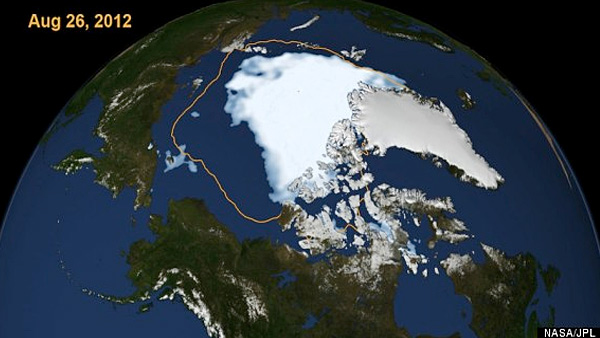
The extent of Arctic sea ice on Aug. 26, 2012, the day the sea ice dipped to its smallest extent ever recorded in more than three decades of satellite measurements. The line on the image shows the average minimum extent from the period covering 1979-2010. Click on the image for a larger version. (NASA/JPL)
The record loss of Arctic sea ice this summer will echo throughout the weather patterns affecting the U.S. and Europe this winter, climate scientists said this week, since added heat in the Arctic influences the jet stream and may make extreme weather and climate events more likely.
The “astounding” loss of sea ice this year is adding a huge amount of heat to the Arctic Ocean and the atmosphere, said Jennifer Francis, an atmospheric scientist at Rutgers University in New Jersey. “It’s like having a new energy source for the atmosphere.” Francis was one of three scientists on a conference call Wednesday to discuss the ramifications of sea ice loss for areas outside the Arctic. The call was hosted by Climate Nexus.
On August 26, Arctic sea ice extent broke the record low set in 2007, and it has continued to decline since, dropping below 1.5 million square miles. That represents a 45 percent reduction in the area covered by sea ice compared to the 1980s and 1990s, according to the National Snow and Ice Data Center (NSIDC), and may be unprecedented in human history. The extent of sea ice that melted so far this year is equivalent to the size of Canada and Alaska combined.
The loss of sea ice initiates a feedback loop known as Arctic amplification. As sea ice melts, it exposes darker ocean waters to incoming solar radiation. The ocean then absorbs far more energy than had been the case when the brightly colored sea ice was present, and this increases water and air temperatures, thereby melting even more sea ice.
Peter Wadhams, the head of the polar ocean physics group at the University of Cambridge in the U.K., told BBC News on September 6 that the added heat from sea ice loss is equivalent to the warming from 20 years of carbon dioxide emissions. Carbon dioxide is the main greenhouse gas that is causing manmade global warming.
Read more at Climate Central
We invite you to add your charity or supporting organizations' news stories and coming events to PVAngels so we can share them with the world. Do it now!
Celebrate a Healthy Lifestyle
 From activities like hiking, swimming, bike riding and yoga, to restaurants offering healthy menus, Vallarta-Nayarit is the ideal place to continue - or start - your healthy lifestyle routine.
 Banderas Bay offers 34 miles of incomparable coastline in the states of Jalisco and Nayarit, and home to Puerto Vallarta and Riviera Nayarit's many great destinations.