
| Mining for Gold: A Pact With the Devil? John Cavanagh and Robin Broad - NationofChange | |
| go to original September 1, 2012 |
 |
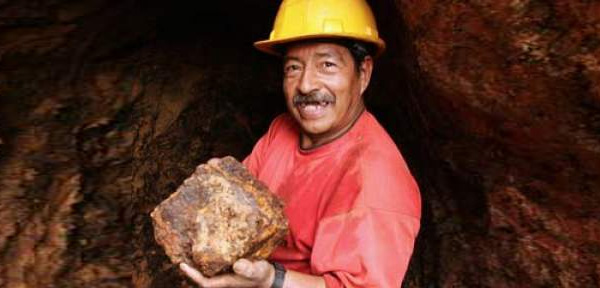
“The water‘s bright orange,” we exclaim while balancing ourselves precariously on rocks alongside a spring. We are visiting the community of San Sebastian in the province of La Union in the northeast corner of El Salvador. Above us stands a mountain with a prominent slash where U.S. and other firms mined gold for over a century, a mountain that also happens to be a key watershed for this area.
“I’ve seen this water also cranberry red and also bright yellow,” our companion responds. But then she quickly adds: “Remember: don’t touch the water. Last time I was here, I slipped and ended up with rashes all over my leg and stomach where I got wet.” She doesn’t need to remind us. Experts from the Salvadoran government’s Ministry of the Environment and Natural Resources were here in July 2012 and they found levels of cyanide and iron that were through the roof.
What at first seems odd is that there hasn’t been commercial gold mining here for at least a decade - since the U.S. company Commerce Group left. But, as we learn on this, our second, research trip to El Salvador, a decade or two can be a blink of an eye for the environmental havoc wreaked by gold mining. These ancient mountains contain not only gold and many other minerals, but also sulfide. It is a deadly combination with long-term consequences: once the mining excavations expose sulfide to the air and rain, it is converted to sulfuric acid. With each new rain, the acid unleashes new toxic substances down the mountain and into the springs and streams. In a nutshell: a long-term poisoning of the water, the land, and the people.
The now-orange spring water flows into a now-lifeless stream that flows into the San Sebastian river that, in turn, flows into the Santa Rosa river. Along the way, the water is used by many before it enters the Gulf of Fonseca far to the south and continues its journey.
The technical term for the environmental nightmare that is unfolding in front of us is “acid mine drainage.” Acid mine drainage has plagued mine sites from Pennsylvania to El Salvador for centuries. Mining expert Robert Goodland stresses that some communities near ancient Roman mines in England and Spain continue to suffer the effects of acid mine drainage over 2,000 years after the mines were closed. And remediation - or “clean up” - is technically and financially challenging. As a local college student who has studied the situation here explains: even if the funding were available, “we wouldn’t be able to clean this up even in 100 years.”
We spend the next day with Father Lorenzo, a handsome man in his early forties with an easy, dimpled smile, who is the priest from the nearby city of Santa Rosa de Lima. Father Lorenzo leads us up the mountain to the site where Commerce Group mined. On the way, we walk by homes built on land covered by finely crushed rocks, or “tailings” - what remains when the mining companies use cyanide to separate the gold from the surrounding rock. We walk on roads and paths built from the tailings.
As with the water, so too “this land is heavily contaminated,” Father Lorenzo sighs. In the words of a local man whose father worked for Commerce Group: large-scale mining involved “making a pact with the devil.”
Near the top of the mountain, we enter the mines: jagged holes carved into the mountainside, with piles of rock below, here and there a glint suggesting the ore that lies within. It is not hard to figure out where Fr. Lorenzo now stands in terms of mining: a dramatic mural outside his church depicts a denuded landscape darkened by mining. But, we ask, how did Father Lorenzo and the community discover that the mountain we are standing on was a toxic nightmare?
NationofChange fights back with one simple but powerful weapon: the truth. Can you donate $5 to help us?
Read more at NationofChange
Robin is a Professor of International Development at American University in Washington, D.C. and has worked as an international economist in the U.S. Treasury Department and the U.S. Congress. John is director of the Institute for Policy Studies, and is co-chair (with David Korten) of the New Economy Working Group. They are co-authors of three books and numerous articles on the global economy, and have been traveling the country and the world for their project Local Dreams: Finding Rootedness in the Age of Vulnerability.
We invite you to add your charity or supporting organizations' news stories and coming events to PVAngels so we can share them with the world. Do it now!
Celebrate a Healthy Lifestyle
 From activities like hiking, swimming, bike riding and yoga, to restaurants offering healthy menus, Vallarta-Nayarit is the ideal place to continue - or start - your healthy lifestyle routine.
 Banderas Bay offers 34 miles of incomparable coastline in the states of Jalisco and Nayarit, and home to Puerto Vallarta and Riviera Nayarit's many great destinations.