
| Scientists Test New Marine Robot Hurricane-Hunters Harriet McLeod - Reuters | |
| go to original September 1, 2012 |
 |
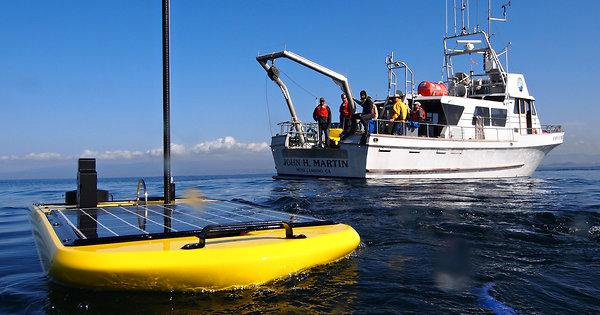
As Tropical Storm Isaac was on its path through the Caribbean before becoming a hurricane in the Gulf of Mexico this week, U.S. scientists were testing an experimental new weather spy tool - an unmanned, marine robot about the size of a surfboard that can gather storm data at sea level.
A National Oceanic and Atmospheric Administration (NOAA)research laboratory in Miami sent the "Wave Glider," a floating platform of sensors with an underwater stabilizer christened Alex, into ocean waters about 100 miles north of Puerto Rico last week to try to intercept Isaac.
"Isaac did not barrel right over it," said Alan Leonardi, deputy director of NOAA's Atlantic Oceanographic and Meteorological Laboratory in Miami, after the storm passed to the south of the island before turning north and making landfall near New Orleans as a Category 1 hurricane.
"But Isaac being the size storm it is, the Wave Glider was able to collect data from the outer rain bands. We can't steer a hurricane, but we did get good data out of it."
A few days later, scientists got a second look at Isaac, from another Wave Glider - named G2 - on a separate oil and gas mission in the Gulf of Mexico.
The eye of Isaac passed barely 60 miles east of G2, enabling it to collect valuable ocean data, including evidence of a dramatic drop in water temperature, "suggesting that Isaac was vacuuming the heat from the Gulf," according to its manufacturers, Liquid Robotics, based in Sunnyvale, California.
Bill Vass, CEO of Liquid Robotics, grew up in Louisiana and is a veteran of hurricanes. His grandparents died in Hurricane Camille in 1969, and his family lost a home to Katrina.
Read more at The Chicago Tribune As Tropical Storm Isaac was on its path through the Caribbean before becoming a hurricane in the Gulf of Mexico this week, U.S. scientists were testing an experimental new weather spy tool - an unmanned, marine robot about the size of a surfboard that can gather storm data at sea level.
A National Oceanic and Atmospheric Administration (NOAA)research laboratory in Miami sent the "Wave Glider," a floating platform of sensors with an underwater stabilizer christened Alex, into ocean waters about 100 miles north of Puerto Rico last week to try to intercept Isaac.
"Isaac did not barrel right over it," said Alan Leonardi, deputy director of NOAA's Atlantic Oceanographic and Meteorological Laboratory in Miami, after the storm passed to the south of the island before turning north and making landfall near New Orleans as a Category 1 hurricane.
"But Isaac being the size storm it is, the Wave Glider was able to collect data from the outer rain bands. We can't steer a hurricane, but we did get good data out of it."
A few days later, scientists got a second look at Isaac, from another Wave Glider - named G2 - on a separate oil and gas mission in the Gulf of Mexico.
The eye of Isaac passed barely 60 miles east of G2, enabling it to collect valuable ocean data, including evidence of a dramatic drop in water temperature, "suggesting that Isaac was vacuuming the heat from the Gulf," according to its manufacturers, Liquid Robotics, based in Sunnyvale, California.
Bill Vass, CEO of Liquid Robotics, grew up in Louisiana and is a veteran of hurricanes. His grandparents died in Hurricane Camille in 1969, and his family lost a home to Katrina.
Read more at The Chicago Tribune
Additional reporting by David Adams; Editing by David Adams and Todd Eastham
We invite you to add your charity or supporting organizations' news stories and coming events to PVAngels so we can share them with the world. Do it now!
Celebrate a Healthy Lifestyle
 From activities like hiking, swimming, bike riding and yoga, to restaurants offering healthy menus, Vallarta-Nayarit is the ideal place to continue - or start - your healthy lifestyle routine.
 Banderas Bay offers 34 miles of incomparable coastline in the states of Jalisco and Nayarit, and home to Puerto Vallarta and Riviera Nayarit's many great destinations.