
| 5 Crazy Ideas to Save Coral Reefs Julia Whitty - Mother Jones | |
| go to original August 31, 2012 |
 |
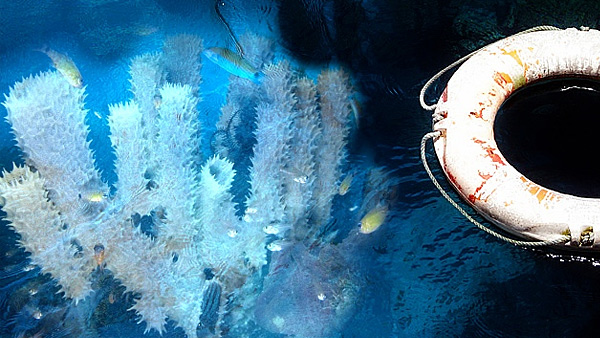
How are we going to save coral reefs in a world where carbon dioxide is changing the temperature and chemistry of the ocean at a rate unprecedented in 300 million years?
"We urge that the marine science and management communities actively solicit and evaluate all potential marine management strategies, including unconventional ones."
Three marine ecologists have written a persuasive paper in Nature Climate Change arguing that the time has come to seriously consider rolling up our sleeves and doing something.
"It's unwise to assume we will be able to stabilize atmospheric CO2 at levels necessary to reduce or prevent ongoing damage to marine ecosystems," says coauthor Ove Hoegh-Guldberg. "In lieu of dealing with the core problem - increasing emissions of greenhouse gases - these techniques and approaches could ultimately represent the last resort. I hope we don't end up in the position but we must at least be prepared."
Here are a few suggestions worthy of exploration, suggest the authors, even if only on a small scale:
- Deploying buoyant shade cloth (it's been tried on the Great Barrier Reef) to protect corals from heat stress that leads to bleaching and death
- Using electrical current to stimulate coral growth and mitigate bleaching
- Trying selective breeding or genetic engineering to help species develop biological resistance and adaptation
- Maintaining or managing ocean chemistry by adding base minerals such as carbonates and silicates to neutralize acidity and help marine creatures make their shells/skeletons
- Convert CO2 from land-based waste into dissolved bicarbonates to add to the ocean for carbon sequestration and reduced ocean acidity
Why the urgency?
Well, while some species may be able to adapt to change by migrating deeper into the ocean or further from the equator, it's not going to be easy. For instance, the Great Barrier Reef would have to migrate south at the rate of nearly 10 miles (15 kilometers) a year to keep pace with the predicted increases in ocean temperatures.
"The magnitude and rapidity of these changes is likely to surpass the ability of numerous marine species to adapt and survive," Hoegh-Guldberg says.
The open-access paper: Greg H. Rau, Elizabeth L. McLeod & Ove Hoegh-Guldberg. The need for new ocean conservation strategies in a high-carbon dioxide world. Nature Climate Change. 2012. doi:10.1038/nclimate1555
We invite you to add your charity or supporting organizations' news stories and coming events to PVAngels so we can share them with the world. Do it now!
Celebrate a Healthy Lifestyle
 From activities like hiking, swimming, bike riding and yoga, to restaurants offering healthy menus, Vallarta-Nayarit is the ideal place to continue - or start - your healthy lifestyle routine.
 Banderas Bay offers 34 miles of incomparable coastline in the states of Jalisco and Nayarit, and home to Puerto Vallarta and Riviera Nayarit's many great destinations.