
| Helicopters Prove Their Worth on Jalisco Wildfire Juan Pablo Vigueras - Vertical | |
| go to original August 24, 2012 |
 |
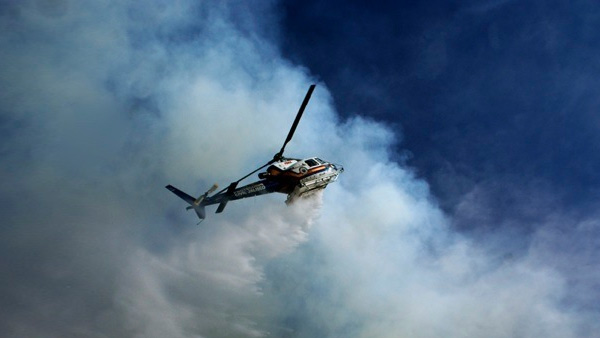
Three Eurocopter AS350 B3 AStars equipped with 290 US gallon (1,100-liter) Simplex 310 Fire Attack tank systems played a key role in battling an April wildfire near Guadalajara. The Simplex tank’s ability to refill from small streams was of particular value during firefighting efforts. (Juan Pablo Vigueras)
The 2012 fire season is in full swing in North America, and helicopters have been proving their worth in battling wildfires not only in the United States and Canada, but in Mexico as well.
One of the most noteworthy of these efforts occurred in April, when helicopters were critical in fighting a forest fire in the state of Jalisco, in west-central Mexico, that threatened one of its major urban areas. This human-caused fire started on April 21 in the Primavera forest, a 75,000-plus acre reserve located near the country’s second-largest city, Guadalajara, where about 4.5 million people live in its metropolitan area. During the first 24 hours of the fire, about 300 firefighters battled the blaze, assisted by a Bambi-Bucket-equipped Bell UH-1 operated by Comisión Nacional Forestal (Mexico’s national forestry commission).
By the next day, however, the fire had grown significantly enough that four helicopters from the Jalisco government had joined the fight. These included a Bell 412 and three Eurocopter AS350 B3 AStars equipped with 290 US gallon (1,100-liter) Simplex 310 Fire Attack tank systems.
After the helicopters arrived at the command post, it was determined that two AStars and the UH-1 would perform direct suppression roles, making drops from the Simplex tanks and Bambi Bucket at strategic points around the fire. Simultaneously, the 412 and the other AStar would insert more than 300 forest firefighters into hot zones, in addition to conducting reconnaissance flights to determine the areas affected by the fire.
One of the great virtues of the Simplex system was demonstrated during the third day of the battle, when one of the fire fronts had spread into a remote area, meaning that tank and bucket refilling operations, and helicopter refueling operations, were delaying water drops. Observing this, pilot Jorge Salvatori, of the Jalisco state government's Grupo Aéreo Fénix, landed his AStar near a small stream close to the front, directing his crew to dig a trench in the stream deep enough for the Simplex’s pump suction to operate. With travel time minimized, the helicopter was able to make more drops on the fire, preventing it from progressing toward an area of 200 homes.
On the fourth day of the fire, three Mil Mi-17s operated by the Mexican air force, equipped with 660 US gallon Bambi Buckets, joined the suppression efforts.
Finally, on the sixth day, the Jalisco “state commission of forest firefighting and prevention” reported that the helicopters and some 800 firefighters assigned to the blaze had managed to contain it. While the total area affected was 19,350 acres — more than a quarter of the forest reserve — the damage would have been significantly greater without the contributions of the helicopters and the hard work of their crews.
We invite you to add your charity or supporting organizations' news stories and coming events to PVAngels so we can share them with the world. Do it now!
Celebrate a Healthy Lifestyle
 From activities like hiking, swimming, bike riding and yoga, to restaurants offering healthy menus, Vallarta-Nayarit is the ideal place to continue - or start - your healthy lifestyle routine.
 Banderas Bay offers 34 miles of incomparable coastline in the states of Jalisco and Nayarit, and home to Puerto Vallarta and Riviera Nayarit's many great destinations.