
| No Sea Ice in the Arctic in a Decade, Scientists Warn Kristina Chew - Care2.com | |
| go to original August 14, 2012 |
 |
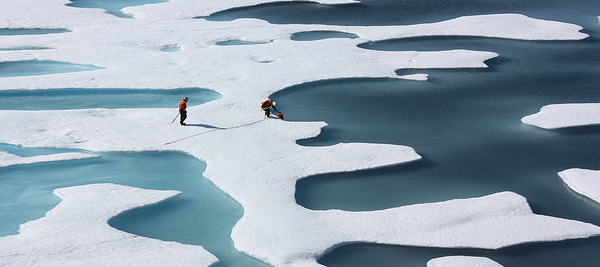
More bad news (I guess there isn’t so much that has been good) about the effects of climate change and rising greenhouse gas emissions on the environment. The European Space Agency‘s CryoSat-2 satellite — the world’s first specifically built to study sea ice thickness — has found that the Arctic’s sea ice is disappearing at a far faster rate than previously thought. The satellite has discovered that the Arctic ocean has lost approximately 900 cubic kilometers of summer sea ice over the past year, 50 percent more than had been thought.
By way of comparison, the Guardian cites previous figures for sea ice:
- In 2004, the volume of sea ice in the Arctic ocean was 17,000 cubic kilometers.
- This winter, CryoSat found that it was 14,000 cubic kilometers.
Scientists say that, if the sea ice continues to disappear at such a rate, there will be no sea ice in the summer in about a decade.
The implications are huge: With no sea ice in the summer, a rush on the region’s fish stocks, oil, minerals and sea routes could be unleashed. The Guardian describes additional effects:
Without the cap’s white brilliance to reflect sunlight back into space, the region will heat up even more than at present. As a result, ocean temperatures will rise and methane deposits on the ocean floor could melt, evaporate and bubble into the atmosphere. Scientists have recently reported evidence that methane plumes are now appearing in many areas. Methane is a particularly powerful greenhouse gas and rising levels of it in the atmosphere are only likely to accelerate global warming. And with the disappearance of sea ice around the shores of Greenland, its glaciers could melt faster and raise sea levels even more rapidly than at present.
Professor Chris Rapley of University College London also notes that, with the temperature differences between the Arctic and the equator declining, lower latitudes could see more “volatility” in the weather as was seen this year, as it is “possible that the jet stream in the upper atmosphere could become more unstable.”
The loss of the sea ice is a stark reminder of how interconnected the planet’s weather systems are, with what happens in low attitudes affecting the high latitudes and vice versa.
Sea ice has also thinned substantially in other regions north of Canada and Greenland. A decade ago, ice thickness was at around five to six meters but levels have now dropped to one to three meters.
Another UCL scientist, Seymour Laxon, emphasized caution about the results from Cryo-Sat-2 as they are only based on preliminary studies. For instance, Laxon points out that the rate of sea ice loss is less in winter when “ice is growing more rapidly than it did in the past and that this effect is compensating, partially, for the loss of summer ice.” But scientists concur that “the trend for ice coverage in Arctic is definitely downwards, particularly in summer.”
In the poem “Fire and Ice,” Robert Frost wrote that “some say the world will end in fire, / some say in ice” — but the chances for the latter seem to be fast disappearing.
We invite you to add your charity or supporting organizations' news stories and coming events to PVAngels so we can share them with the world. Do it now!
Celebrate a Healthy Lifestyle
 From activities like hiking, swimming, bike riding and yoga, to restaurants offering healthy menus, Vallarta-Nayarit is the ideal place to continue - or start - your healthy lifestyle routine.
 Banderas Bay offers 34 miles of incomparable coastline in the states of Jalisco and Nayarit, and home to Puerto Vallarta and Riviera Nayarit's many great destinations.