
| Rights Groups Hail Mexican Court Decision Adriana Gomez Licon and Michael Weissenstein - Associated Press | |
| go to original August 10, 2012 |
 |
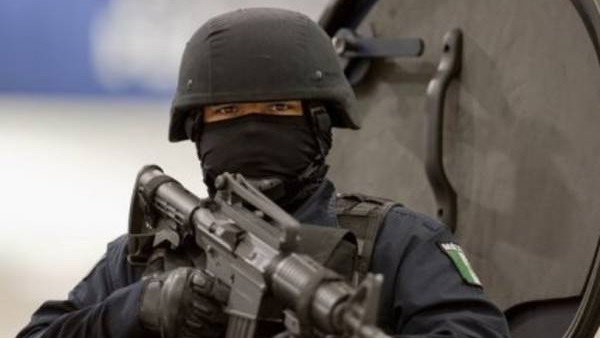
MEXICO CITY — Human rights groups were jubilant Friday after Mexico's Supreme Court dealt a blow to a military justice system accused of covering up human-rights violations by soldiers suspected of abusing, torturing and executing citizens during a six-year government offensive against drug cartels.
Complaints about mistreatment of civilians skyrocketed after President Felipe Calderon sent tens of thousands of soldiers and marines to battle drug cartels across Mexico starting in late 2006. Victims' advocates say troops battling heavily armed criminal gangs in Mexican cities and rural areas often show little respect for civil rights, sweeping up innocent young men along with legitimate suspects and extracting false confessions with physical abuse.
Government records obtained by Mexican press and rights groups show that military prosecutors opened nearly 5,000 investigations into alleged violations of rights between 2007 and April 2012 but only 38 service members were convicted and sentenced.
The military court system has not changed despite international pressure and repeated government pledges to shift jurisdiction to civilian courts in many of the cases. In 2010 the U.S. government held back $26 million in aid due to human rights concerns, including the military justice issue.
Now the Supreme Court appears to be close to overturning the system after a ruling Thursday in the case of Jethro Ramses Sanchez, a 27-year-old auto mechanic who authorities say was tortured and killed by soldiers at a military base last year after he was arrested by police at a fair in the city of Cuernavaca.
Soldiers posted at the base have told investigators they heard Sanchez screaming in pain during his detention.
One of the soldiers' commanders, Col. Jose Guadalupe Arias Agredano, was charged with covering up the crime by telling soldiers not to talk about it and ordering several to dump his body on empty land in the neighboring state of Puebla. Sanchez was found two months later.
Local military and civilian courts disagreed over which of them should handle the case, with both trying not to get involved. Sanchez's family and lawyers from human rights groups took the case to the Supreme Court along with 29 other cases involving questions of civilian or military jurisdiction over soldiers accused of violating the rights of civilians.
In its first ruling, the Supreme Court's ministers voted 8-2 to refer the case to a civilian court, many using language that made clear they believe the current military justice system is not the place to hear cases involving civilian victims.
"A soldier should never be judged by a military court when the victim is a civilian and their human rights have been violated," Minister Arturo Zaldívar said.
The court must issue similar rulings in four other cases in order to establish a precedent that would be followed by courts across Mexico.
Rights advocates said similar rulings seemed almost certain, and they welcomed what appeared to be the imminent end of troops' protection from civilian courts in cases where the victims are civilians.
"This is a landmark decision of the Supreme Court," said Jose Miguel Vivanco, Americas director for Human Rights Watch. "Military jurisdiction plays a fundamental role in covering up human rights atrocities committed by security forces, particularly the army."
Sanchez's relatives are hopeful that the Supreme Court decision will lead to significant change, said their lawyer, Octavio Amezcua of the nongovernmental Mexican Commission for the Defense and Promotion of Human Rights.
"What they want is for what happened to Jethro not to happen to other young people," Amezcua said. "If this can be a way for the same thing not to happen again, they see it as something positive.
"This decision provides guarantees that victims of human rights violations can obtain justice from an impartial and transparent court."
Other experts, however, say that Mexico's civilian justice system has done little to prevent similar abuses by the police officers who fall under its jurisdiction.
"The civil system of penal justice in Mexico doesn't work either," said Alejandro Anaya Muñoz, an analyst at the Center for Economic Research and Instruction, an independent think tank. "They are better in terms that they are more transparent and more accessible to human rights lawyers and activists, but they don't work in practice."
We invite you to add your charity or supporting organizations' news stories and coming events to PVAngels so we can share them with the world. Do it now!
Celebrate a Healthy Lifestyle
 From activities like hiking, swimming, bike riding and yoga, to restaurants offering healthy menus, Vallarta-Nayarit is the ideal place to continue - or start - your healthy lifestyle routine.
 Banderas Bay offers 34 miles of incomparable coastline in the states of Jalisco and Nayarit, and home to Puerto Vallarta and Riviera Nayarit's many great destinations.