
| Mexico's Political Evolution Dan Cothran - Arizona Republic | |
| go to original July 28, 2012 |
 |
 |
Many people in Mexico and the United States are wondering if the election on July 1 has brought back the bad old days by returning "power to the party that ruled for more than 70 years using patronage, corruption and repression."
This is a valid concern, but I believe the Mexican political system has changed profoundly since 1988 and is highly unlikely to revert to the bad old days. In fact, the transformation of Mexican politics has been going on for a century, and the recent election, even with allegations of vote-buying, can be seen as the latest step in the long process of political evolution of our southern neighbor.
The process has not been smooth, unidirectional or fast, but by looking quickly over the past few decades, we can discern a rough pattern away from authoritarianism and instability and toward a liberal democracy that is widely accepted by all parties. Mexico may have taken longer than it should have, but it is getting there.
Almost with each succeeding election from the 1930s to the 1980s - with some notable setbacks such as in the late 1960s and early 1970s, a tumultuous period in many countries - the Mexican political system opened, however slowly, to more diverse participation and party competition.
Before 1982, Institutional Revolutionary Party candidates usually claimed 85 to 95 percent of the popular vote. In 1982, the PRI candidate claimed only 74 percent of the vote, an indication of the direction the system was moving - toward greater recognition of criticism and competition.
The real turning point came in the 1980s. After decades of relatively strong economic growth, Mexico experienced severe economic recessions in 1976 and 1982 and almost no growth from 1983 to 1988.
In 1985 an 8.0-magnitude earthquake hit Mexico City, causing more than 10,000 deaths and serious damage to the city, with more than 400 buildings collapsing. The president and his government were perceived as almost absent in the early days of the crisis, and so, citizens organized themselves into groups to try to rescue survivors in collapsed buildings.
All these events, economic and seismic, contributed to the delegitimizing of the PRI regime that had been going on slowly for years because of repression, an erratic economy and a changing population that was becoming more middle-class.
In 1988, Mexico experienced a political tremor. Cuauhtemoc Cardenas, the son of former President Lazaro Cardenas, ran for president as candidate of a coalition of opposition parties and claimed victory, although the PRI once again took the election, this time by a mere 50 percent of the vote. Whether "fair" or not, this election was certainly more competitive than any previous one.
Each election from 1982 on was more competitive than the ones before.
Now, the handwriting was on the wall; the PRI could no longer simply "take" elections with whatever methods it chose. It must slug it out with two other parties, a social-democratic one and a conservative pro-business one.
From 1988 on, the pace of political change sped up. In 1994, the PRI once again claimed victory but with less than 50 percent of the vote. From 1982 on, each succeeding election seemed to be closer and closer to actually being "fair." In addition, other parties won more seats in the Congress, making it necessary for a president of any party to govern with a greater degree of consultation with a range of political forces.
If 1988 saw a tremor, the election of 2000 brought a full-scale political earthquake that shook the system to its foundations, as an opposition candidate won the presidency for the first time in Mexican history. This is always one of the fundamental tests of how democratic a political system is: Can the opposition win national executive power, not just a few local offices?
What the U.S. had accomplished in 1800, Mexico did 200 years later. In 2006, the conservative National Action Party, or PAN, once again won the presidency, although by such a razor-thin margin (35.89 to 35.31 percent) over the leftist Democratic Revolution Party, or PRD, that the latter protested vehemently that the election had been rigged and should be redone.
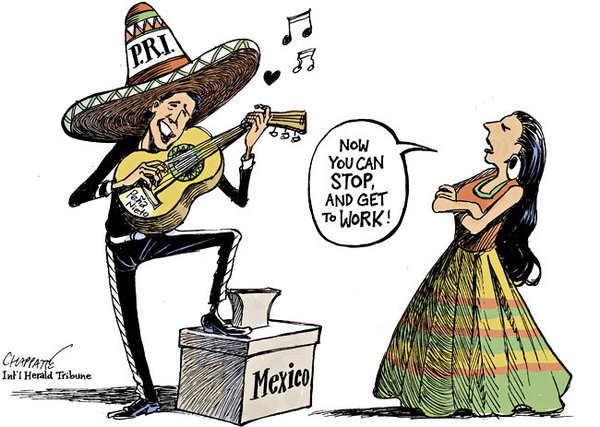
Now in 2012, the PRI has regained the presidency in the person of Enrique Peña Nieto, who apparently won with a mere 38 percent of the popular vote, while the PRD candidate came in second with 32 percent in official results. Thus, this latest stage of political evolution suggests that the former authoritarian party has more or less learned to play by the rules, and the Mexican political system has become more and more competitive.
To Americans accustomed to a relatively placid political history, these may seem like small steps indeed, but for Latin American and many other less-industrialized countries, Mexico's political achievements have been impressive. This is not meant to minimize the toughness of the PRI during much of its rule, which included numerous political murders, often of journalists.
Nor is any of this meant to suggest that political evolution is unilinear, predictable or completely benign. The recent U.S. experience demonstrates how a political system can regress to a state of bitter conflict and near-paralysis. Yet, despite the many bumps along the way, this recent election confirms Mexico's continuing march toward a more stable, liberal democracy. If the PRI tries to revert to its authoritarian past, after more than 25 years of political mobilization, Mexico would probably explode.
What will keep Mexico on the road to liberal democracy? The same thing that keeps any country on that path - not because would-be authoritarians have abandoned their desire for power and privilege, but because political culture and institutions have changed dramatically in the past couple of decades since 1988.
The country has a more middle-class population that demands a more democratic and participatory political system and an electoral process that produces greater competitiveness and fairer elections, which in turn have produced a more diverse Congress.
The road ahead may be volatile, but it seems unlikely that Mexico will return to the bad old days of one-party rule. Underlying cultural and institutional conditions have changed too much for that.
Dan Cothran, a professor emeritus of political science at Northern Arizona University, taught about Latin America, comparative policy and public administration from 1982 to 2007. He is the author of "Political Stability and Democracy in Mexico: The 'Perfect Dictatorship?'."
We invite you to add your charity or supporting organizations' news stories and coming events to PVAngels so we can share them with the world. Do it now!
Celebrate a Healthy Lifestyle
 From activities like hiking, swimming, bike riding and yoga, to restaurants offering healthy menus, Vallarta-Nayarit is the ideal place to continue - or start - your healthy lifestyle routine.
 Banderas Bay offers 34 miles of incomparable coastline in the states of Jalisco and Nayarit, and home to Puerto Vallarta and Riviera Nayarit's many great destinations.