
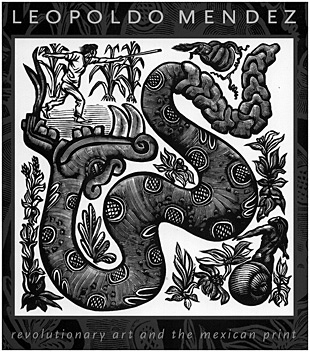
| Revolutionary Art and the Mexican Print Deborah Caplow - University of Texas Press | |
| go to original July 27, 2012 |
 |
 |
The artists of Mexico who lived through the ten-year Revolution were lucky. Not only did they survive upheaval, starvation, and the ruination of the country, but then they had the chance to experience the glorious artistic explosion that followed.
We are speaking here of the years from 1920 to 1940, the time of Diego Rivera, David Siqueiros, José Orozco, Frida Kahlo, and the talented practitioners of Mexican engraving: Jean Charlot, Ramón Alva de la Canal, Pablo O'Higgins, and, probably the greatest of them all, Leopoldo Méndez.
As opposed to the politically and socially castrated American artists of the 20s, Rivera, Siqueiros, Méndez et al were deeply involved in the politics of their country, if not the world. Many were also involved in government projects to bring Art to the People. In the United States, and belatedly, this was administered by the WPA. In Mexico, it was brought about through the ægis of the Ministry of Education. Méndez himself spent a year or so as a teacher in villages of Central Mexico.
His main shtick, there in the sticks, was to get rid of Oscar Wilde's notion of "Art for Art's Sake." Art was, as he and Rivera and Siqueiros saw it, to free the workers, to lighten the burden of the campesinos, to uplift the poor, to unburden the rich of their excessive wealth.
Méndez was a dedicated printmaker and painter, a self-sacrificing revolutionary, a loyal comrade, and a good friend. He comes across as self-effacing, dedicated, more interested in communicating the evils of greed and violence rather than, like Rivera, pumping up his own balloon. His most moving prints are not the sometimes crude caricatures of captains of warfare and industry, but views of the humble peasant, the worker in the field, the poor drudges in the factories, the scattered heirs of Emiliano Zapata.
He also comes across as a trooper, a charmer, a persuasive writer. During the Depression, he made his first trip to America, and recalled the wonder of being approached by a poor gringo in Arizona:
I remember a man, tall and strong, who came up to us on the street, saying, "I haven't had breakfast. I haven't eaten. Yesterday I had work and today I don't." Later he explained to us, "I dared to approach you because you are Mexican. My countrymen don't like me and won't give me anything."
On the way north, he tells of a surprising find: "The wind brought us the miasma of a nearby cadaver. With a lantern we went to look for it and ..."
I was astonished by the spectacle of a dead dog in a state of decomposition, covered by butterflies with silvery wings, carnivorous butterflies that were devouring it. What a shame! I should have made a drawing with the fresh impression of this sight. It was like a dream.
In later years, what with the cold war and all, Méndez and his fellow artists were deemed too dangerous to be allowed to travel in the United States. He died in 1969, and a friend, Maples Arce, wrote, "he possessed the precious gift of sincerity, constantly reflected in his conduct and his work."
Leopoldo Méndez was always a congenial companion; he had a peaceful nature, without affectation or roughness, and he was frank without falling into rudeness.
"An ingenuous grace," Arce concluded, "brought him close to popular culture, and he was always a man of the people."
We invite you to add your charity or supporting organizations' news stories and coming events to PVAngels so we can share them with the world. Do it now!
Celebrate a Healthy Lifestyle
 From activities like hiking, swimming, bike riding and yoga, to restaurants offering healthy menus, Vallarta-Nayarit is the ideal place to continue - or start - your healthy lifestyle routine.
 Banderas Bay offers 34 miles of incomparable coastline in the states of Jalisco and Nayarit, and home to Puerto Vallarta and Riviera Nayarit's many great destinations.