
| Colombia's Cocaine Crop Up, US Aid Down Eric Martin - Associated Press | |
| go to original July 26, 2012 |
 |
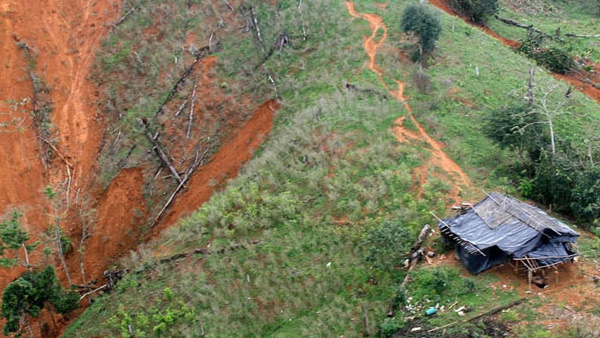
A cocaine lab and an array of empty plastic containers for coke-processing chemicals sit precariously on a mountainside. (El Colombiano)
MEXICO CITY — Colombia's production of illegal coca climbed last year for the first time since 2007 as U.S. military aid fell 20 percent, stretching resources dedicated to eradicating the plant used to make cocaine.
A study by the United Nations Office on Drugs and Crime published Wednesday shows that land under coca leaf cultivation rose 3 percent to 64,000 hectares (158,150 acres) in 2011 from 62,000 in 2010. Coca growing increased for the first time in Colombia in four years after the United States reduced military and economic aid to $542 million in 2011 from $681 million in 2010.
The coca rebound is significant because "it represents a break in the momentum Colombia appeared to have since 2007," Adam Isacson, an analyst at the Washington Office on Latin America, said in an email. "It may simply be that Colombia and the U.S. have devoted less budget to manual eradication, which has declined pretty steeply every year."
While aerial spraying of coca with chemical pesticides has cut production from 144,800 hectares in 2001, Colombia remains the biggest supplier of cocaine to the U.S.
Colombia was once the biggest recipient of U.S. foreign aid outside the Middle East and Afghanistan, but aid has declined in recent years as security forces wrested control of rural areas from Marxist guerrillas who fund themselves via the drug trade.
Colombian President Juan Manuel Santos has pledged to continue the government's eradication programs amid signs that illegal armed groups are regrouping in far-flung parts of the Andean nation.
While coca production declined in 14 of Colombia's 24 provinces last year, it jumped 80 percent to 13,280 hectares in Caqueta and Putumayo, the southern region and guerrilla stronghold where the U.S.-led Plan Colombia kicked off more than a decade ago.
The U.N. agency said that coca leaf yields per hectare have decreased, probably as farmers cut back on fertilizers and agro- chemicals, reducing potential cocaine production in 2011 by 1 percent to 345 tons.
Last year, the government eradicated 35,152 hectares of coca manually, down from 43,986 hectares in 2010, while crop dusters sprayed 103,302 hectares compared with 101,940 hectares in 2010, according to Defense Ministry data.
While Colombian production of coca has dropped in the past decade, output increased by more than 50 percent in Bolivia and by more than 30 percent in Peru, the U.N. said in a separate report last month.
We invite you to add your charity or supporting organizations' news stories and coming events to PVAngels so we can share them with the world. Do it now!
Celebrate a Healthy Lifestyle
 From activities like hiking, swimming, bike riding and yoga, to restaurants offering healthy menus, Vallarta-Nayarit is the ideal place to continue - or start - your healthy lifestyle routine.
 Banderas Bay offers 34 miles of incomparable coastline in the states of Jalisco and Nayarit, and home to Puerto Vallarta and Riviera Nayarit's many great destinations.