
| Earthquake-Report: Popocatepetl, Mexico Armand Vervaeck - Earthquake-Report | |
| go to original July 14, 2012 |
 |
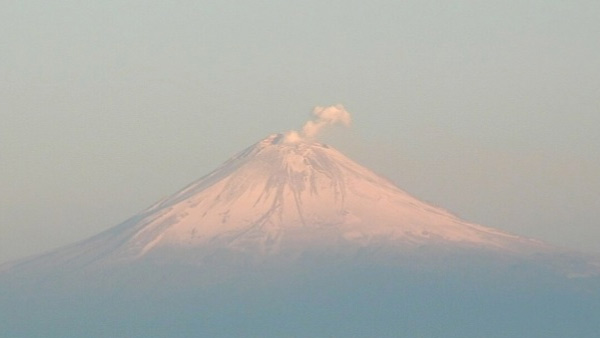
Popocatepetl volcano (David Tuggy/Wikipedia)
Volcán Popocatépetl, whose name is the Aztec word for smoking mountain, towers to 5426 m 70 km SE of Mexico City to form North America’s 2nd-highest volcano.
The glacier-clad stratovolcano contains a steep-walled, 400 x 600 m wide crater. The generally symmetrical volcano is modified by the sharp-peaked Ventorrillo on the NW, a remnant of an earlier volcano. At least three previous major cones were destroyed by gravitational failure during the Pleistocene, producing massive debris-avalanche deposits covering broad areas south of the volcano.
The modern volcano was constructed to the south of the late-Pleistocene to Holocene El Fraile cone. Three major plinian eruptions, the most recent of which took place about 800 AD, have occurred from Popocatépetl since the mid Holocene, accompanied by pyroclastic flows and voluminous lahars that swept basins below the volcano.
Frequent historical eruptions, first recorded in Aztec codices, have occurred since precolumbian time. The first Spanish ascent of the volcano was made by an expedition led by Diego de Ordaz in 1519. The early 16th-century monasteries on the slopes of the mountain are a World Heritage Site.
Eruptions
Popocatepetl is one of the most active volcanoes in Mexico, having had more than 15 major eruptions since the arrival of the Spanish in 1519. A major eruption occurred in 1947.
On December 21, 1994, the volcano spewed gas and ash which was carried as far as 25 km (16 mi) away by prevailing winds. The activity prompted the evacuation of nearby towns and scientists to begin monitoring for an eruption.
In December 2000, tens of thousands of people were evacuated by the government based on the warnings of scientists. The volcano then made its largest display in 1,200 years.
On December 25, 2005, the volcano’s crater produced an explosion which ejected a large column of smoke and ash about 3 km (1.9 mi) into the atmosphere and expulsion of lava.
In January and February of 2012, scientists have been noticing Popocatepetl’s action increasing. On January 25, 2012, an ash explosion occurred on the mountain causing much dust and ash to contaminate the atmosphere around it.
On April 19, 2012 there were reports of superheated rock fragments being hurled into the air by the volcano. Ash and water vapor plumes were reported 15 times over 24 hours. The activity still continued while writing this article (July 13). It can be followed in our Daily Volcano Activity reports.
We invite you to add your charity or supporting organizations' news stories and coming events to PVAngels so we can share them with the world. Do it now!
Celebrate a Healthy Lifestyle
 From activities like hiking, swimming, bike riding and yoga, to restaurants offering healthy menus, Vallarta-Nayarit is the ideal place to continue - or start - your healthy lifestyle routine.
 Banderas Bay offers 34 miles of incomparable coastline in the states of Jalisco and Nayarit, and home to Puerto Vallarta and Riviera Nayarit's many great destinations.