
| Mexico's New President Political Descendant of Anti-Church Party, but With a Difference Matthew Cullinan Hoffman - NCRegister.com | |
| go to original July 12, 2012 |
 |
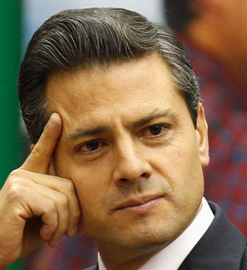 |
| Enrique Peña Nieto (Reuters) |
MEXICO CITY — The results of Mexico’s presidential elections, completed last week, have been a source of concern and even consternation for many, both among Mexicans themselves and foreign observers. The narrative, mimetically transmitted through the international media, is a deceptively simple one: The Leviathan party that ruled Mexico for more than 70 years, the legendary “perfect dictatorship,” has returned to power.
Indeed, the Institutional Revolutionary Party (PRI), which had a stranglehold on Mexican politics for generations, quashing dissent through a combination of repression and graft, has earned its reputation for corruption, a reputation that it is finding difficult to shed.
The party’s historic role in the oppression of Catholics only adds to the unease of some, who fear the return of anti-clerical policies that once pitted Church against state and excluded expressions of faith from the public square. American moviegoers have only recently been treated to a portrayal of the presidency of the PRI’s infamous founder, Plutarco Elias Calles, whose persecution of the Catholic Church sparked a bloody civil war in the late 1920s. It was dramatized in the new film For Greater Glory.
The impending election of now president-elect Enrique Peña Nieto, the PRI’s 2012 candidate for the highest office in the land, spurred massive protests from students from both public and private universities across the country. They drove the candidate out of one university, organized marches, and created an organization called Yo Soy 132 (“I am the 132nd”), in reference to the 131 original protesters who began the movement. Yo Soy 132 even managed to organize an additional presidential debate, which was attended by all of the candidates except Peña Nieto himself.
Unfortunately, the behavior of the PRI during the election in some ways tended to confirm the suspicions of many that the party is still up to its old tricks. The Peña Nieto campaign has been accused of distributing gift cards redeemable at supermarkets to potential voters, as well as exceeding campaign spending limits by millions of dollars and purchasing media endorsements. Although all of the parties have been accused of electoral abuses, the PRI campaign appears to have been particularly unrestrained in its efforts to elect its candidate.
Return to the Past?
Mexicans may have reason for trepidation at the return of the PRI, but fears of a return to the country’s old repressive system are almost certainly exaggerated. Mexico is simply not the country it was from 1929 to 1988, the period of the PRI’s political monopoly. Not only does the country have a lively multiparty system and authentic freedom of speech and press, but Mexico can to some extent thank the PRI itself for the creation of that very system.
The PRI began to cede authority to other parties as early as 1988, when it lost control of the country’s lower legislative house, the Chamber of Deputies, while at the same time rigging the presidential election in its favor, in a bungled fraud that would prove to be its undoing. The controversy and outrage engendered by the clearly falsified election results would lead to the creation of the Federal Electoral Institute by the PRI-led government in 1990, an institution that would virtually eliminate vote-rigging and make a multi-party system truly possible.
Although the PRI would regain control of the Chamber of Deputies in 1991, the party continued to implement reforms during the 1990s. Most notably for Catholics, it established diplomatic relations with the Holy See, and modified the constitution to permit Catholic education, and to allow priests to vote and wear their clerical garb in public. Repression of the Catholic Church became little more than an ugly memory.
It was a new PRI that, in 2000, committed the unprecedented act of ceding the presidency itself to Vicente Fox Quesada, the candidate of the historically pro-Catholic National Action Party (PAN). Fox’s six-year term would be followed by another six-year term by the PAN’s Felipe Calderón Hinojosa. The two presidents implemented a number of reforms, including the expansion of medical services for the poor, and oversaw a massive reduction in poverty.
Decline of the Catholic-Friendly PAN
However, the years of Panista rule have not all been bright for Mexican Catholics. Although Calderon fought the legalization of abortion in Mexico City in both the legislature and the courts, it failed to appoint Supreme Court justices that would protect the right to life and family values, resulting in approval for Mexico City’s abortion-on-demand and homosexual “marriage” laws. Last year, the Supreme Court failed to impose abortion on the entire country by only one vote, with seven of 11 justices voting to overturn state right-to-life constitutional amendments on “human rights” grounds.
At the state level, elected representatives of the PAN, with heavy cooperation from the PRI, managed to pass right-to-life amendments in 17 states, in a defensive measure against the extension of Mexico City’s abortion law. However, President Calderón’s administration was simultaneously responsible for the creation of Official Mexican Norm 046, a regulation that requires all hospitals throughout the country to perform abortions or dispense the abortifacient “morning after pill” in rape cases.
The Calderón administration has also overseen an explosion in homicides related to drug trafficking deaths that has canceled the gains made in public safety during the earlier part of the decade. More than 60,000 people have died in Calderón’s war against illegal drugs, a period that has been marked by numerous accusations of human rights abuses and corruption against the military and federal police forces. On top of the humanitarian catastrophe of thousands of lost lives, the country has suffered the effects of the global recession, adding to dissatisfaction with Panista rule.
For many Mexicans, the PRI has never lost its luster as a party. Although the party long ago lost its absolute majority in both houses of the national legislature, it has maintained a plurality there for all but two three of the 20 years of Mexico’s new democratic system. It has also maintained a grip on about half of the country’s 31 states. In recent elections, the PAN has slipped to a third place position at the national level, behind the socialist Party of the Democratic Revolution (PRD)
Although Catholics may be discomfited at the decline of the PAN, they can take heart in the fact that the Mexican people have chosen a president who not only lacks the old hostility of the PRI towards Catholicism, but has actively courted the Catholic vote. Peña Nieto made headlines several years ago when, during a visit to the Vatican, he told Pope Benedict about his engagement, in an obvious attempt to shore up support among the faithful. The PRI long ago made peace with the Catholic Church and religious liberty. Moreover, in a multi-party democracy, it would seem inevitable that the PRI would eventually get its turn, yet again, at the helm.
In fact, the bitterest enemy of Peña Nieto and the PRI seems not to be the pro-Catholic PAN, but the PRD, whose candidate, Manuel López Obrador, came in a distant second in the presidential election. His party, which has proven to be the principle foe of the right to life and family values, is attacking the legitimacy of the PRI’s victory, while Panistas, including Felipe Calderón and Vicente Fox, have conceded defeat.
Register correspondent Matthew Cullinan Hoffman writes from Mexico City.
We invite you to add your charity or supporting organizations' news stories and coming events to PVAngels so we can share them with the world. Do it now!
Celebrate a Healthy Lifestyle
 From activities like hiking, swimming, bike riding and yoga, to restaurants offering healthy menus, Vallarta-Nayarit is the ideal place to continue - or start - your healthy lifestyle routine.
 Banderas Bay offers 34 miles of incomparable coastline in the states of Jalisco and Nayarit, and home to Puerto Vallarta and Riviera Nayarit's many great destinations.