
| Back-to-Back La Ninas Cooled Globe and Influenced Extreme Weather in 2011 NOAA | |
| go to original July 11, 2012 |
 |
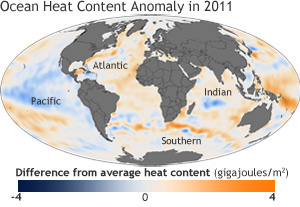 |
| La Niña chilled the eastern tropical Pacific in 2011, but ocean heat content nearly everywhere else was above the long-term average. (NOAA Climate Portal) |
Worldwide, 2011 was the coolest year on record since 2008, yet temperatures remained above the 30 year average, according to the 2011 State of the Climate report released online today by NOAA. The peer-reviewed report, issued in coordination with the American Meteorological Society (AMS), was compiled by 378 scientists from 48 countries around the world. It provides a detailed update on global climate indicators, notable weather events and other data collected by environmental monitoring stations and instruments on land, sea, ice and sky.
"2011 will be remembered as a year of extreme events, both in the United States and around the world," said Deputy NOAA Administrator Kathryn D. Sullivan, Ph.D. "Every weather event that happens now takes place in the context of a changing global environment. This annual report provides scientists and citizens alike with an analysis of what has happened so we can all prepare for what is to come."
Two back-to-back La Niñas, each characterized by cooler-than-average water temperatures in the eastern equatorial Pacific, affected regional climates and influenced many of the world's significant weather events throughout the year. These included historic droughts in East Africa, the southern United States and northern Mexico. La Niña conditions contributed to an above-average tropical cyclone season in the North Atlantic hurricane basin and a below-average season in the Eastern North Pacific. It was also associated with the wettest two-year period (2010–2011) on record in Australia, which was particularly remarkable as the wet conditions followed a decade-long dry spell.
The Arctic continued to show more rapid changes than the rest of the planet. Sea ice shrank to its second smallest "summer minimum" extent on record during 2011, as older ice (four to five years old) reached a new record minimum at more than 80 percent below average. Overall, glaciers around the world continued to lose mass. Loss from Canadian Arctic glaciers and ice caps were the greatest since measurements began in 2002.
The report used 43 climate indicators to track and identify changes and overall trends to the global climate system. These indicators include greenhouse gas concentrations, temperature of the lower and upper atmosphere, cloud cover, sea surface temperature, sea level rise, ocean salinity, sea ice extent and snow cover. Each indicator includes thousands of measurements from multiple independent datasets.
Highlights:
- Warm temperature trends continue: Four independent datasets show 2011 among the 15 warmest since records began in the late 19th century, with annually-averaged temperatures above the 1981–2010 average, but coolest on record since 2008. The Arctic continued to warm at about twice the rate compared with lower latitudes. On the opposite pole, the South Pole station recorded its all-time highest temperature of 9.9°F on December 25, breaking the previous record by more than 2 degrees.
- Greenhouse gases climb: Major greenhouse gas concentrations, including carbon dioxide, methane, and nitrous oxide, continued to rise. Carbon dioxide steadily increased in 2011 and the yearly global average exceeded 390 parts per million (ppm) for the first time since instrumental records began. This represents an increase of 2.10 ppm compared with the previous year. There is no evidence that natural emissions of methane in the Arctic have increased significantly during the last decade.
- Arctic sea ice extent decreases: Arctic sea ice extent was below average for all of 2011 and has been since June 2001, a span of 127 consecutive months through December 2011. Both the maximum ice extent (5.65 million square miles, March 7) and minimum extent (1.67 million square miles, September 9) were the second smallest of the satellite era.
- Ozone levels in Arctic drop: In the upper atmosphere, temperatures in the tropical stratosphere were higher than average while temperatures in the polar stratosphere were lower than average during the early 2011 winter months. This led to the lowest ozone concentrations in the lower Arctic stratosphere since records began in 1979 with more than 80 percent of the ozone between 11 and 12 miles altitude destroyed by late March, increasing UV radiation levels at the surface.
The report also provides details on a number of extreme events experienced all over the globe, including the worst flooding in Thailand in almost 70 years, drought and deadly tornado outbreaks in the United States, devastating flooding in Brazil and the worst summer heat wave in central and southern Europe since 2003.
The 2011 State of the Climate report is peer-reviewed and published annually as a special supplement to the Bulletin of the American Meteorological Society. The report is part of a suite of climate services NOAA provides government, business and community leaders so they can make informed decisions. It was edited by Jessica Blunden, Ph.D., and Deke Arndt of NOAA's National Climatic Data Center. The full report can be viewed online. The report highlights are available online.
Additionally, for the first time a complementary article has been published by AMS today examining the linkages between climate change and extreme events of 2011. The paper looks at six global extreme weather and climate events from last year.
Findings:
- Determining the causes of extreme events remains difficult. While scientists cannot trace specific events to climate change with absolute certainty, new and continued research help scientists understand how the probability of extreme events change in response to global warming.
- La Niña-related heat waves, like that experienced in Texas in 2011, are now 20 times more likely to occur during La Niña years today than La Niña years fifty years ago.
- The UK experienced a very warm November 2011 and a very cold December 2010. In analyzing these two very different events, UK scientists uncovered interesting changes in the odds. Cold Decembers are now half as likely to occur now versus fifty years ago, whereas warm Novembers are now 62 times more likely.
- Climate change cannot be shown to have played any role in the 2011 floods on the Chao Phraya River that flooded Bangkok, Thailand. Although the flooding was unprecedented, the amount of rain that fell in the river "catchment" area was not very unusual. Other factors, such as changes in reservoir policies and increased construction on the flood plain, were found most relevant in setting the scale of the disaster.
The paper, Explaining Extreme Events of 2011 from a Climate Perspective, was produced by NOAA and UK Met Offices scientists as well as numerous colleagues around the world. It was edited by Thomas Peterson, NOAA's National Climatic Data Center; Peter Stott, UK Met Office-Hadley Center; and Stephanie Herring, NOAA's Office of Program Planning and Integration.
We invite you to add your charity or supporting organizations' news stories and coming events to PVAngels so we can share them with the world. Do it now!
Celebrate a Healthy Lifestyle
 From activities like hiking, swimming, bike riding and yoga, to restaurants offering healthy menus, Vallarta-Nayarit is the ideal place to continue - or start - your healthy lifestyle routine.
 Banderas Bay offers 34 miles of incomparable coastline in the states of Jalisco and Nayarit, and home to Puerto Vallarta and Riviera Nayarit's many great destinations.