
| Hope Never Dies: Swiss Help Mexicans Tackle Enforced Disappearances Swissinfo | |
| go to original November 25, 2023 |
 |
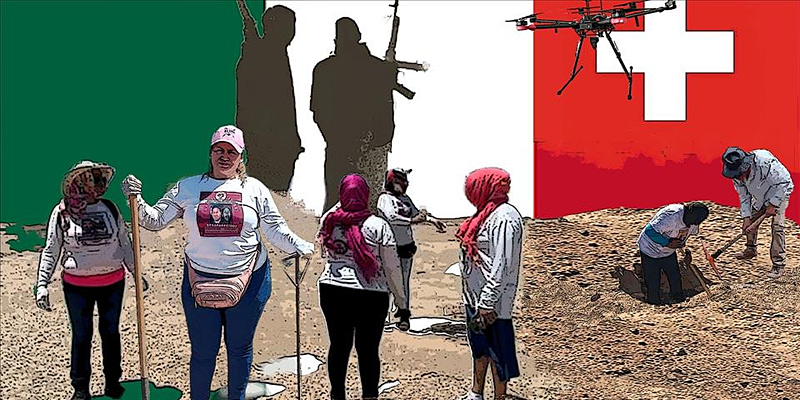
Ceci Patricia Flores, dressed in long sleeves and jeans, a pink cap shielding her face from the sun, buries a wire rod as deep into the ground as she can. She then pulls it out and brings the buried end close to her nose. If she notes the smell of rotting flesh on the rod, it's a sign she must start digging in this exact spot.
This is Flores's daily routine out on the arid terrain of Sonora, a state in northwestern Mexico. The 50-year-old mother of six is searching for the bodies of victims of enforced disappearances in a region where organized crime is rampant.
Among the victims she's looking for are two of her own children. Alejandro, 21, was“disappeared” on October 30, 2015, while travelling from Sonora to the neighboring state of Sinaloa. Marco Antonio, 32, was taken by a cartel in Bahia de Kino, Sonora, on May 4, 2019, together with his younger brother, Jesus Adrian, 15, who was later released.
“Since then, I am like the walking dead,” says Flores, who in 2019 founded the collective Madres Buscadoras de Sonora, the Searching Mothers of Sonora. Each day she's joined in her search by other mothers and family members with a story similar to her own. They are taking matters into their own hands, says Flores, because“the authorities have so far failed to do it.”
Their arduous, unpaid work has extended to other parts of the country, as Mexico faces up to a grim reality: over 110,000 names entered in a national database of missing persons and more than 52,000 unidentified bodies lying either in mass graves or in state morgues. Mexican authorities have labelled it a“forensics crisis” and asked other countries, including Switzerland, for assistance.
Lack of Capacity
For this task, the Swiss foreign ministry tapped the University of Lausanne's School of Criminal Sciences. Together with the University Centre of Legal Medicine Lausanne-Geneva (CURML), in 2022 the school set up courses in forensic science for Mexican officials involved in search and investigation of the disappeared.
So far, 100 participants – ranging from prosecutors and police officers to forensic pathologists and anthropologists – have taken a basic course, offered remotely and focused on crime-scene investigation, forensic analysis and identification of human remains.
“We are coming from such different environments and complexity in terms of cases that it would be ridiculous to say that we can grasp and tackle the problems [the Mexicans] are facing, and it is not our objective,” explains Christophe Champod, director of the Lausanne school.“What we are trying to do is give them a methodology that they can apply in their own situation.”
That situation is nothing short of daunting. The vast majority of disappearances in Mexico have occurred since the mid-2000s, when authorities launched their war on drugs to root out cartels. Each year, thousands of people disappear at the hands of organized criminal groups or those of government forces.
Read the rest at MENAFN
Related: Women at CDMX March Against Violence (Reporte Diario)
Related: Mexico’s Federal Government Seeks to Hide Women Victims of Violence: Xóchitl (Quadratin Jalisco)
We invite you to add your charity or supporting organizations' news stories and coming events to PVAngels so we can share them with the world. Do it now!
Celebrate a Healthy Lifestyle
 From activities like hiking, swimming, bike riding and yoga, to restaurants offering healthy menus, Vallarta-Nayarit is the ideal place to continue - or start - your healthy lifestyle routine.
 Banderas Bay offers 34 miles of incomparable coastline in the states of Jalisco and Nayarit, and home to Puerto Vallarta and Riviera Nayarit's many great destinations.