
| Acapulco Can Rebuild From Hurricane Otis. But What About Violent Crime? Lorena Rios and Samantha Schmidt - The Washington Post | |
| go to original November 6, 2023 |
 |
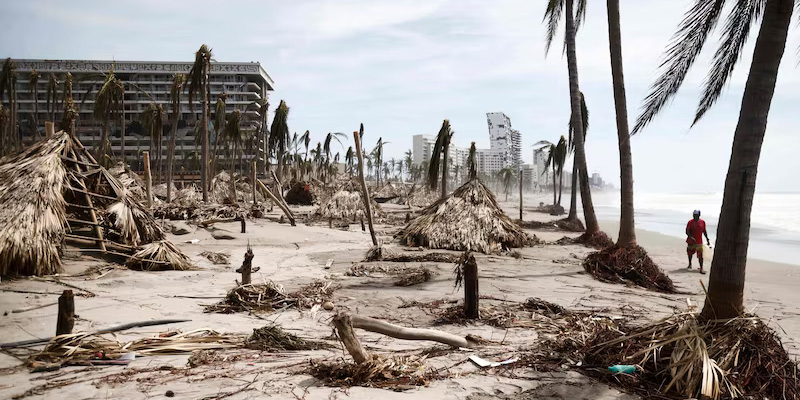

Hurricane Otis tore facades from hotels, flattened beach huts and snapped palm trees in two when it slammed into Acapulco on Oct. 25 as a Category 5 storm. (Rodrigo Oropeza/Getty Images)
Update: Acapulco’s Recovery Moves Ahead in Fits and Starts After Hurricane Otis Devastation (Associated Press)
Before Hurricane Otis tore through this once-famed Pacific Coast resort, the Las Olas luxury condominium complex was already expecting a dismal turnout for this Día de los Muertos weekend.
The wealthy owners of the oceanfront vacation homes were too afraid to visit.
Not long ago, condominiums here might have expected 30 to 40 percent occupancy on a typical long weekend. That was far less than during Acapulco’s heyday decades ago, but it was something.
Heading into this weekend, administrator Karla Navarrete said, the complex was expecting only 5 to 10 percent occupancy. Many would-be visitors, she said, feared being robbed or kidnapped on the highway in.
Then came Otis. The most powerful storm recorded in the eastern Pacific smashed into Acapulco on Oct. 25, ripping chunks out of the 16-floor building and exposing a skeleton of girders, rods and cables. Forty-six people are dead and 56 are missing, authorities said Friday; people here believe both numbers are likely significantly higher.
But the Category 5 hurricane was only the latest calamity to hit Acapulco. The coronavirus pandemic kept visitors away. And organized criminal groups have made the city a battleground.
From the 1940s to the 1970s, Acapulco was Mexico’s pearl of the Pacific, the glitzy resort where John and Jacqueline Kennedy honeymooned and Frank Sinatra, Elizabeth Taylor and Cary Grant vacationed.
The resort city has suffered a long, slow decline for decades. As it became one of Mexico’s most dangerous cities, international tourism plummeted. The U.S. State Department advises U.S. citizens against traveling to Guerrero state, a warning it shares with Haiti, Somalia and North Korea, among others. The U.S. government forbids its employees from visiting Acapulco.
The number of foreign visitors to the resort dropped 63 percent from 2012 to 2017. Then the pandemic paralyzed tourism. And now Hurricane Otis has just about wiped out business altogether.
About 95 percent of Acapulco’s 280 hotels are damaged or destroyed, according to the city’s hotel association. Virtually all of the condominiums in the Zona Diamante — the touristic Diamond District — are ruined. Eighty percent of restaurants were devastated by the storm.
In a city where 57,000 people are employed by hotels and restaurants, the hurricane’s attack could be a death blow.
But government officials and tourism industry leaders are expressing hope that reconstruction will offer an opportunity to update and even rebrand Acapulco as the premier tourist destination it once was.
Read the rest at Washington Post
Related: Mexico’s Hurricane Reconstruction Plans Prioritize Military Barracks, Owners Left to Rebuild Hotels (Associated Press)
Related: As Devastated Acapulco Rebuilds, Other Mexico Resorts Urged to Heed Its Lessons (Reuters)
Related: Hurricane Otis Exacerbates Vulnerability to Cartel Exploitation Amid Rebuilding Efforts (Puerto Vallarta News)
Related: How Acapulco Became Mexico's Murder Capital (Washington Post)
We invite you to add your charity or supporting organizations' news stories and coming events to PVAngels so we can share them with the world. Do it now!
Celebrate a Healthy Lifestyle
 From activities like hiking, swimming, bike riding and yoga, to restaurants offering healthy menus, Vallarta-Nayarit is the ideal place to continue - or start - your healthy lifestyle routine.
 Banderas Bay offers 34 miles of incomparable coastline in the states of Jalisco and Nayarit, and home to Puerto Vallarta and Riviera Nayarit's many great destinations.