
| A New Border Crossing: Americans Turn to Mexico for Abortions Zolan Kanno-Youngs and Edyra Espriella - The New York Times | |
| go to original September 25, 2023 |
 |
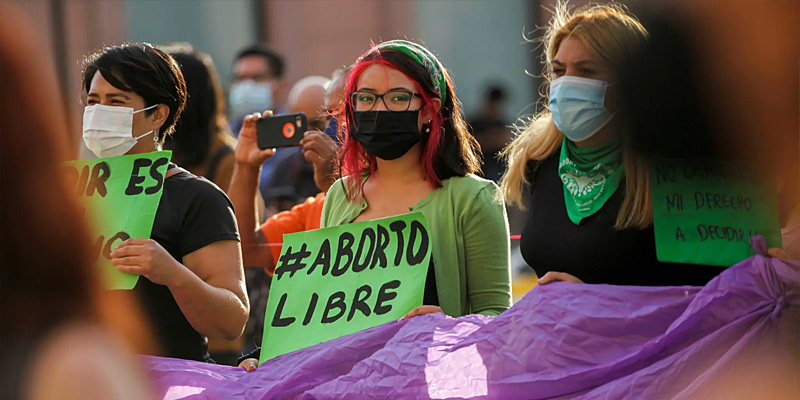

A woman holds a sign in support of abortion rights at a demonstration in Mexico. (Daniel Becerril/Reuters)
The text message Cynthia Menchaca received this summer was one she was seeing more and more: A woman living in Texas said she had left a violent relationship only to discover she was pregnant, and she desperately wanted an abortion. The woman had learned that Ms. Menchaca could send her abortion pills from Mexico, where the procedure has been decriminalized in several states.
But the growing U.S. demand for abortion care is not limited to deliveries of medication, according to advocates like Ms. Menchaca, who lives in Coahuila state in northeastern Mexico.
Clinics in Tijuana and Mexico City, as well as activists in the northwestern city of Hermosillo, say they have seen women crossing the border from Texas, Louisiana and Arizona seeking access to abortion.
“Before, the women from Sonora would go to the United States to access abortions in clinics,” said Andrea Sanchez, an abortion-rights activist, referring to the Mexican state that borders Arizona. “And now the women from the United States come to Mexico.”
More than a year after the U.S. Supreme Court overturned Roe v. Wade, Mexican abortion-rights activists have seen a rise of American women crossing the border to seek abortions — crystallizing the shifting policies of two nations that once held vastly different positions on the procedure.
For decades, abortion was criminalized in Mexico and much of Latin America with few exceptions, while in the United States, the 1973 Roe v. Wade ruling established a constitutional right to abortion.
Today, Mexico’s Supreme Court has decriminalized abortion nationwide, making it legally accessible in federal institutions and eliminating federal penalties for the procedure. Twelve of the country’s 32 states have also decriminalized abortion, and activists say they have renewed momentum to push local officials in the remaining states.
By comparison, more than 20 American states currently ban or restrict the procedure after 18 weeks of pregnancy or earlier, with 14 states completely forbidding the procedure in almost all circumstances.
Mexican activists, anticipating the Supreme Court could overturn Roe when it was still weighing the case, began organizing and have established an underground system, sending thousands of pills north and helping women travel south across the border. They say the longstanding restrictions in Latin America prepared them to now handle the influx of demand.
“The truth is that years ago, we neither had nor envisioned collaboration with the United States,” said Verónica Cruz, who 20 years ago helped found the reproductive-rights organization Las Libres, which means “the free ones.”
Read the rest at The New York Times
Related: ‘Women Need to Know It Is No Longer a Crime’: Mexico’s Abortion Companions – In Pictures (The Guardian)
We invite you to add your charity or supporting organizations' news stories and coming events to PVAngels so we can share them with the world. Do it now!
Celebrate a Healthy Lifestyle
 From activities like hiking, swimming, bike riding and yoga, to restaurants offering healthy menus, Vallarta-Nayarit is the ideal place to continue - or start - your healthy lifestyle routine.
 Banderas Bay offers 34 miles of incomparable coastline in the states of Jalisco and Nayarit, and home to Puerto Vallarta and Riviera Nayarit's many great destinations.