
| Unearthing a Maya Civilization That ‘Punched Above Its Weight’ Franz Lidz - The New York Times | |
| go to original September 13, 2022 |
 |
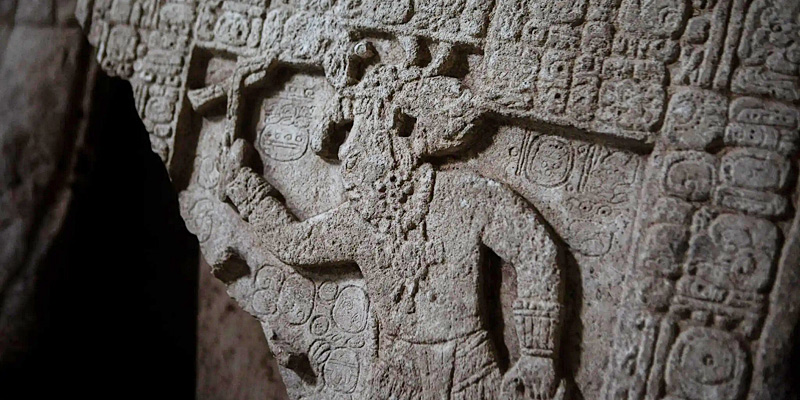
On a bright, buggy morning in early summer, Charles Golden, an anthropologist at Brandeis University, slashed through the knee-high grass of a cattle ranch deep in the Valle de Santo Domingo, a sparsely populated region of thick brush and almost impenetrable jungle. Only the raucous half-roar, half-bark of howler monkeys pierced the ceaseless mating call of cicadas. “We’re coming to what’s left of the Sak Tz’i’ dynasty,” Dr. Golden said.
Dr. Golden approached a barbed wire fence enclosing a pasture, then limboed under it and surveyed the vista beyond: the crumbling ruins of Sak Tz’i’, a Maya settlement at least 2,500 years old. Spread across 100 acres of tangled vines and lumpy earth were reminders of lost grandeur: giant heaps of rock and rubble that had once been temples, plazas, reception halls and a towering, terraced palace.
Directly ahead were the remains of a complex of platforms that had formed the acropolis. In its prime, it was dominated by a 45-foot-high pyramid in which members of the royal family might have been entombed. Where the pyramid and several elite residences once stood were toppled walls of cut stone. Dr. Golden noted that the entrance to the pyramid had probably featured a line of free-standing relief sculptures, called stelae, most of which were now buried in the debris or had been hacked off and carried away by thieves.
To the southeast he noted an alley filled with scree — it was a timeworn ball court, 350 feet long and 16 feet wide with sloping sides. The game, a religious event symbolizing regeneration, required players to keep a solid rubber ball aloft using only their hips and shoulders. Nearby, amid what had been a cluster of ceremonial centers, was a jumble of stones where commoners would have gathered for public observances and kings would have held court. Dr. Golden pointed to the former courtyard, now a jigsaw mound. “From this place,” he said, “the Sak Tz’i’ rulers sought to command their subjects — successfully or not — and engaged with the politics of a landscape over which multiple kingdoms struggled for control.”
Small and scrappy, Sak Tz’i’ — White Dog, in the language of ancient Mayan inscriptions — was the sometime ally, sometime vassal, sometime foe of several of the largest and most powerful regional players, including Piedras Negras in what is now Guatemala and Bonampak, Palenque, Tonina and Yaxchilan in present-day Chiapas. The dynasty flourished during the Classic period of Maya culture, from 250 to 900 A.D., when the civilization counted its greatest achievements in architecture, engineering, astronomy and mathematics.
For reasons that are still unclear, Sak Tz’i’ and hundreds of other settlements were abandoned and entire regions were left deserted during the ninth century. Although descendants still live in the region, the vagaries of nature buckled temple walls, the tomb robbers disassembled pyramids and a thickening jungle canopy concealed plazas and causeways. Sak Tz’i’ was effectively erased from memory.
Scholars began searching for physical evidence of the realm only in 1994, when epigraphers reading a stela — found a century earlier at a dig in Guatemala — realized that a glyph described the capture of a Sak Tz’i’ king in 628 A.D.
Three summers ago, a team of researchers and local work crews led by Dr. Golden and Andrew Scherer, a bioarcheologist at Brown University, explored the pasture and discovered the remains of dozens of stone stelae, cooking tools and the corpse of a middle-aged woman who had died at least 2,500 years earlier. Radiocarbon dating indicated that the site, which the researchers named Lacanjá Tzeltal after the nearby modern community, was likely colonized by 750 B.C. and occupied until the end of the Classic period. Perhaps most remarkably, Dr. Golden and Dr. Scherer established that the cattle ranch had been a — if not the — capital of the Sak Tz’i’ dynasty.
Read the rest at The New York Times
Related: Ancient City of Cacaxtla Ruled a Large Swath of Mexico — And Then a Volcano Erupted (Mexico News Daily)
Related: Over 50 Pre-hispanic Artifacts Returned to Mexico From Abroad (Mexico News Daily)
We invite you to add your charity or supporting organizations' news stories and coming events to PVAngels so we can share them with the world. Do it now!
Celebrate a Healthy Lifestyle
 From activities like hiking, swimming, bike riding and yoga, to restaurants offering healthy menus, Vallarta-Nayarit is the ideal place to continue - or start - your healthy lifestyle routine.
 Banderas Bay offers 34 miles of incomparable coastline in the states of Jalisco and Nayarit, and home to Puerto Vallarta and Riviera Nayarit's many great destinations.