
| AMLO’s Road to 20 Million Votes to Become President Is More Difficult Than Many Appreciate Victor Herrera - Americas Quarterly | |
| go to original October 11, 2017 |
 |
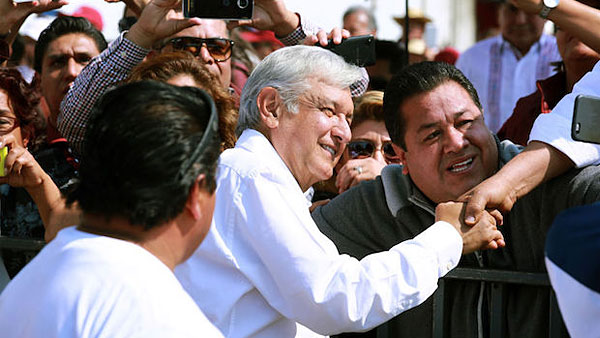
Even with the presidential field split, it will be a challenging path to victory for the leftist candidate. (Susana Gonzalez/Bloomberg)
A question institutional investors often ask regarding Mexico’s presidential elections next year is: Can Andrés Manuel López Obrador actually win? Most polls do indeed put the leftist former mayor of Mexico City, known popularly by his initials, AMLO, ahead of hypothetical adversaries today. But the road to the 20 million votes he likely needs to become president is more difficult than many appreciate.
The most obvious caveat to the recent polls is that AMLO is, so far, the only certain candidate for 2018. Other parties have not yet settled on their candidates. This leaves room for Mexico’s political landscape to become a lot more complex – as it did last Thursday, when Mexican media reported on former first lady Margarita Zavala’s prospects of launching her own campaign as an independent. But the other challenges AMLO faces have to do with electoral math, signs that his base is narrowing, and the ways that Mexico has evolved since 2006, when he came within a whisker of winning the presidency.
That year, AMLO received 14.7 million votes, representing 35 percent of turnout, while President Felipe Calderón won with 36 percent of the total (Mexico does not have a second round or runoff). In 2012, 15.8 million people voted for AMLO (32 percent of the total), while President Enrique Peña Nieto won with 39 percent of the tally.
Most observers believe that, in a split race, 35 percent of the vote will be enough in 2018. That is probably equivalent to 20 million votes. In an interview with the daily newspaper Reforma in July, AMLO said that he had believed reaching that number was feasible.
One can argue that the best moment for AMLO in the past showdowns was in 2006, as he received the highest percentage of votes. And this makes sense, as at that time the left was united, embracing his candidacy under the Partido de la Revolución Democrática (PRD). He also was backed by a number of intellectuals and some private sector industrialists. More importantly, the Partido Revolucionario Institucional (PRI) ran a very weak candidate.
AMLO’s support began to erode after he lost that election by a slim margin and blocked Mexico City’s most important street with protesters for months.
Read the rest at Americas Quarterly
Related: Presidential Candidate Margarita Zavala Splits from National Action Party (Stratfor)
Related: PAN Leader Urges Mexico’s Former First Lady Not to Run for President as Independent (FT.com)
We invite you to add your charity or supporting organizations' news stories and coming events to PVAngels so we can share them with the world. Do it now!
Celebrate a Healthy Lifestyle
 From activities like hiking, swimming, bike riding and yoga, to restaurants offering healthy menus, Vallarta-Nayarit is the ideal place to continue - or start - your healthy lifestyle routine.
 Banderas Bay offers 34 miles of incomparable coastline in the states of Jalisco and Nayarit, and home to Puerto Vallarta and Riviera Nayarit's many great destinations.