
| Violent Crime in Mexico Is at 20-Year High. This Is Why Our Political Parties Don’t Fix It Jennifer Bejar and Michael Wilson Becerril - The Washington Post | |
| go to original September 29, 2017 |
 |
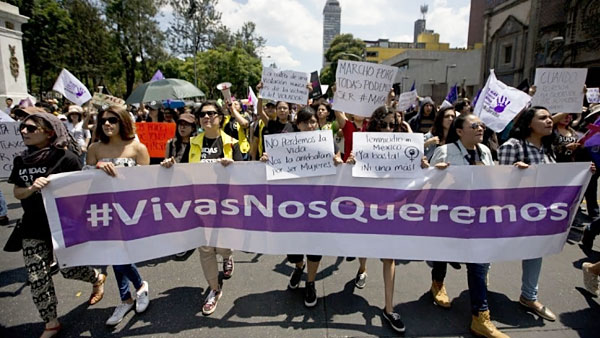
Women carry a banner that reads in Spanish “#We want ourselves alive” during a demonstration to protest violence against women in Mexico City (Eduardo Verdugo/Associated Press)
Mexico has been in the news lately for its devastating earthquakes — and for the number of people organizing donations and helping with rescue operations, independent of a slow-to-react government. But there’s another disaster ravaging the country: Violent crime has reached a 20-year high.
News media show videos of mutilations with electric saws and photographs of corpses hanging from bridges — human billboards sending the message that organized crime is more powerful than the government.
And recent research suggests that instead of working together to stop the violence, Mexico’s highly polarized political parties and weak political institutions may be exacerbating it for political gain.
Although it controls the presidency, Mexico’s ruling Institutional Revolutionary Party, or PRI, lacks a congressional majority and shares power with nine other parties. The PRI frames itself as centrist, putting itself in the middle of wide ideological variation between its eight counterparts and their respective policy proposals. And political scientists Guillermo Trejo and Sandra Ley have argued that the ideological gaps between left and right are not only causing gridlock — but also contributing to the growth of violence.
Trejo and Ley collected data on murders attributed to drug cartels across different regions in Mexico between 1995 and 2006. They found that the rate of cartel-related murders was higher in regions where the local or regional government’s party was different from the party controlling the national government (which was the PRI until 2000; the religious-conservative National Action Party until 2012; and since then, again, the PRI). In municipalities under unified governance, where the same party was in power at both levels, violence was less common.
In simple terms, Trejo and Ley found that the weakness and polarization of Mexico’s political parties facilitates violence. That’s because parties point to rising levels of violence to shame their enemies in power for being unable to reduce it. The parties themselves don’t directly cause violence. But the fact that they are so polarized, skirmishing incessantly for power instead of cooperating for the public good, gives parties an incentive to fail to clamp down on the violence — so that they can use it to discredit opponents.
Read the rest at The Washington Post
Related: Will Mexico Go Down the Populist Route in 2018? (Modern Diplomacy)
Related: Is Mexico the World’s ‘Second-Deadliest Conflict Zone’? Probably Not.] (The Washington Post)
Related: This Is What a Socialist Looks Like (The Nation)
We invite you to add your charity or supporting organizations' news stories and coming events to PVAngels so we can share them with the world. Do it now!
Celebrate a Healthy Lifestyle
 From activities like hiking, swimming, bike riding and yoga, to restaurants offering healthy menus, Vallarta-Nayarit is the ideal place to continue - or start - your healthy lifestyle routine.
 Banderas Bay offers 34 miles of incomparable coastline in the states of Jalisco and Nayarit, and home to Puerto Vallarta and Riviera Nayarit's many great destinations.