
| A Year After Major Citizen Victory, Mexico’s Government Has Yet to Clean Up Its Act Viridiana Rios - Americas Quarterly | |
| go to original September 19, 2017 |
 |
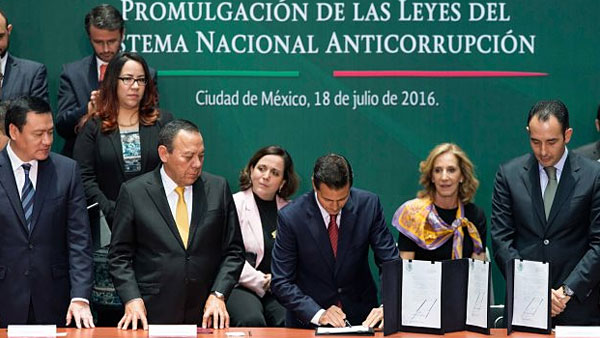
Eighteen months ago, I wrote in AQ about the success of Mexico's citizen-driven corruption fight in Congress. Civil society groups, academics and activists had pushed for the rejection of a watered-down anti-corruption bill and instead presented their own, sharpened version of the legislation. This citizen's bill, called #Ley3de3 (or #Law3of3) promised not only to help identify, punish and prevent corruption, but to do so while promoting collaboration among different federal institutions and citizen groups.
Congress agreed to discuss the bill only after 634,000 citizens signed their support, and approved it only after trying several times to reduce its scope. Passage of the #Ley3de3 thus marked one of the most important breakthroughs for Mexico’s civil society since democratization began in the late nineties.
All of us who were part of this effort knew that it was a first step, but were sure that many more would follow. Little did we know how resistant to outside pressure – from civil society, the media and others – the government would prove to be when it came to cleaning up its act.
Since its passage, Congress has stalled consolidation of the anti-corruption system of which the #Ley3de3 was a critical part. Of the seven chairs that were supposed to oversee and coordinate anti-corruption policies under the bill, one of the most important, that of the anti-corruption prosecutor, remains empty.
The most apparent reason for this is partisan politics. The Mexican Senate, which is tasked with selecting the prosecutor, has instead blocked his or her nomination out of fear of what will follow: A prosecutor with the mandate to conduct criminal proceedings against corrupt officials. Any form of partisan control over the office could turn Mexico’s well-intended anti-corruption battle into a witch hunt against political opponents. The parties in Congress are thus doing what they can do fill the position with a friendly face.
A second reason lies in the creation of Mexico’s first-ever independent attorney general’s office, which will take effect in 2018. When it does, the selection of the anti-corruption prosecutor will become a responsibility of Mexico’s new attorney general. This is a problem. The current attorney general, Raúl Cervantes, is a prominent member of the incumbent party (PRI), and one of its most loyal lawyers. Earlier this month, he was accused of trying to evade taxes on a Ferrari sports car (he chalked the incident up to an administrative error). If Cervantes were to remain in office and assume this new role, the autonomy of the anti-corruption prosecutor could be severely threatened, as he could provide a de facto amnesty to a PRI administration.
Read the rest at Americas Quarterly
Related: Mexico's Appeal for an Impartial Federal Prosecutor General (Global Voices)
We invite you to add your charity or supporting organizations' news stories and coming events to PVAngels so we can share them with the world. Do it now!
Celebrate a Healthy Lifestyle
 From activities like hiking, swimming, bike riding and yoga, to restaurants offering healthy menus, Vallarta-Nayarit is the ideal place to continue - or start - your healthy lifestyle routine.
 Banderas Bay offers 34 miles of incomparable coastline in the states of Jalisco and Nayarit, and home to Puerto Vallarta and Riviera Nayarit's many great destinations.